
Quick Answer
An inline wet blasting system is the right choice when parts must move through surface treatment in a continuous or indexed flow with stable finish quality, lower dust than dry blasting, and less operator-to-operator variation. It is typically selected for precision deburring, coating pretreatment, cosmetic texturing, and repetitive finishing of medium- to high-volume parts. Compared with stand-alone cabinets, inline systems are built for controlled throughput, recipe-based repeatability, and easier integration with upstream machining, washing, inspection, or coating operations.
| Core Factor | Typical Conclusion |
|---|---|
| Process type | Continuous or indexed wet abrasive blasting using water, media, and compressed air |
| Operating mode | Conveyorized, transfer-fixture, rotary, or chamber-to-chamber inline flow |
| Dust behavior | Lower airborne dust than dry blasting because the water phase suppresses fines |
| Best-fit production level | Medium to high throughput with repeat part presentation |
| Common applications | Deburring, edge preparation, scale removal, pretreatment before coating, cosmetic finishing |
| Typical project lead time | Standardized systems are usually faster; custom inline automation is typically longer |
What Is Inline Wet Blasting System
An inline wet blasting system is an industrial surface treatment machine that moves workpieces through wet abrasive blasting in a continuous, semi-continuous, or indexed production sequence. Instead of loading one batch into a cabinet, processing it, and unloading it before the next cycle, an inline arrangement is designed around flow. Parts travel by conveyor, shuttle, rotary indexing fixture, or chamber-transfer mechanism so that blasting becomes part of a linked manufacturing process rather than an isolated finishing step.
Within the broader wet blasting, slurry blasting, and vapor blasting family, the inline format is defined less by the blasting physics and more by the production architecture. The core blasting principle remains the same: abrasive particles are suspended in water, accelerated by compressed air, and directed onto a workpiece surface to clean, deburr, texture, or refine it. What changes is how the parts are presented, how the nozzles are arranged, and how the system maintains cycle-to-cycle continuity.
That production logic makes inline equipment fundamentally different from compact or purely manual blasting cabinets. It is intended for repeat parts, recurring takt requirements, and a clear need to reduce handling between upstream and downstream steps. An inline wet blasting system may therefore sit between machining and washing, between forming and coating, or between additive manufacturing and final inspection.
Its main technical advantages are familiar to wet blasting users. Water suppresses dust, which helps contain fine particulate in the work zone. The water phase can also reduce abrasive impregnation risk on many sensitive or softer surfaces, and the cushioned particle impact often supports a finer, more uniform finish than aggressive dry blasting. When the machine includes recipe control, pressure feedback, and stable slurry concentration management, repeatability improves further.
For line builders and process engineers, the biggest benefit is usually throughput-stable automation. Because part movement, nozzle dwell, blast pressure, and cycle timing can all be standardized, the inline layout supports more predictable output than manual cabinet work. That matters in tool manufacturing, stamped or machined components, coating pretreatment, and cosmetic finishing programs where surface condition affects downstream performance.
Inline wet blasting systems also vary widely in layout. Some are single-lane conveyor machines for flat or plate-like parts. Others are fixture-based shuttles for parts that must be oriented precisely. Double-chamber or transfer-chamber systems may overlap load and blast operations to reduce idle time. In every case, the defining characteristic is that wet blasting is integrated into a production line logic rather than treated as a stand-alone manual station.
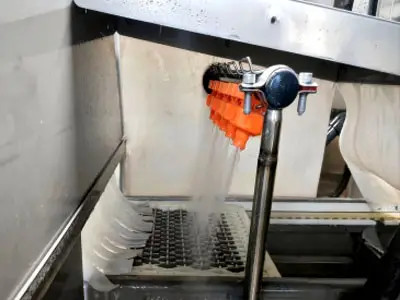
How Does Inline Wet Blasting System Work
An inline wet blasting system works by generating a controlled abrasive slurry, delivering it to one or more blast nozzles, processing parts as they move through a defined path, and recovering the used slurry for recirculation and waste separation. The result is a closed-loop surface treatment process that can be synchronized with line takt, part presentation, and quality-control requirements.
Slurry Preparation in an Inline Wet Blasting System
The system begins with a slurry tank or central process sump where water and abrasive are mixed into suspension. In an inline machine, this stage is especially important because the process does not pause between individual parts in the way a manual cabinet often does. The slurry must remain stable over longer operating periods, with controlled concentration and agitation so that the first workpiece and the hundredth workpiece see comparable blasting conditions.
Media selection is application-dependent. Fine grades are common for edge refinement, cosmetic matte finishes, and sensitive deburring, while coarser grades may be chosen for heavier cleaning or scale removal. In an inline environment, the abrasive must also match the intended maintenance interval, contamination load, and recirculation strategy.
Compressed Air Delivery and Nozzle Energy
From the slurry tank, the mixture is pumped to blast guns or nozzle manifolds, where compressed air accelerates the abrasive stream toward the part surface. In a line system, the nozzle arrangement may be fixed, oscillating, servo-controlled, or programmed to track specific part features. The energy delivered to the substrate depends on the interplay among pressure, nozzle diameter, stand-off distance, media size, impact angle, and exposure time.
Because the parts are moving through the machine, nozzle layout becomes a process-design issue rather than only an operator skill issue. Engineers must determine whether the workpiece should travel past stationary guns, stop at blast stations, rotate in fixtures, or move through multiple chambers. The answer depends on feature geometry, finish uniformity requirements, and target throughput.
Part Handling, Indexing, and Repeatability
Part handling is what makes an inline wet blasting system distinct. The machine may use a belt, mesh conveyor, fixture pallet, rotary carousel, or transfer arm to present the part to the nozzles in a repeatable orientation. Good presentation control limits variation in exposure angle and dwell time, both of which strongly affect the surface result.
For high-value precision parts, the blasting process is often designed around repeatable fixturing first and nozzle pattern second. That is especially true for burr removal, controlled edge conditioning, or cosmetic finishing on visible surfaces. If the part moves unpredictably, even a well-controlled slurry and air circuit cannot fully compensate.
Closed-Loop Recovery, Sedimentation, and Mist Control
After impact, the slurry drains to a recovery area where reusable abrasive and water are recirculated. Spent fines, broken media, removed burr particles, and contamination are separated gradually by sedimentation, screening, or waste-sand removal stages. This closed-loop slurry recovery is central to inline productivity because it reduces interruption, supports more stable media usage, and helps control operating cost.
Water suppresses dry dust, but it does not eliminate the need for extraction. Inline systems require controlled airflow and mist collection to maintain visibility inside the blast zone and prevent moisture carryover into adjacent work areas. That becomes more important when the machine is linked directly to loading automation, washing, drying, or coating operations.
PID Control and Line Integration
For line production, stable output matters more than peak pressure. PID-based control allows the blasting system to hold a target condition despite fluctuations in demand, nozzle wear, or process load. Recipe management in the HMI can store pressure setpoints, nozzle movement, fixture parameters, cycle timing, and alarm thresholds for different part families.
An inline wet blasting system adds value when it converts finishing from a manual step into a controllable production variable.
In advanced layouts, the blasting system exchanges signals with conveyors, robots, barcode systems, or downstream quality checks. That integration is why line builders tend to evaluate wet blasting not only as a finishing technology, but also as a manufacturing-control platform.
| Process Parameter | Typical Inline Practice | Why It Matters |
|---|---|---|
| Working pressure | Typically controlled within a defined recipe window rather than adjusted ad hoc | Determines removal rate, finish consistency, and burr response |
| Slurry concentration | Maintained in a stable band by circulation and periodic correction | Affects aggressiveness, media life, and visual uniformity |
| Abrasive particle size | Fine to medium PSDs are common, selected by application | Influences texture, feature sensitivity, and cleaning intensity |
| Air flow demand | Sized to total nozzle count, duty cycle, and simultaneous blast zones | Prevents pressure drop across a multi-nozzle inline system |
| Media consumption rate | Depends on contamination, breakage, recycle efficiency, and cleaning schedule | Impacts operating cost and maintenance planning |
| Control system | Typically PLC/HMI with PID pressure feedback and stored recipes | Supports repeatability, traceability, and line integration |
Inline Wet Blasting System vs Dry Blasting vs Other Methods
An inline wet blasting system is often evaluated against dry blasting, shot peening, and vibratory finishing because all can modify a surface, yet they solve different production problems. The most relevant comparison is not whether one process is universally better, but how each fits a specific combination of throughput, finish target, dust control, and downstream process sensitivity.
Dry blasting remains effective where aggressive cleaning or roughening is the priority and dust management infrastructure is already strong. For continuous production lines handling precision or cosmetic parts, however, dry media can introduce more housekeeping burden and greater sensitivity to airborne particulate. General process background appears in [abrasive blasting terminology], while peening-specific context is covered by [shot peening terminology].
Inline wet blasting also compares favorably in coating-related production where substrate consistency matters. In protective-finish workflows, the condition of the prepared surface can strongly influence later performance, an issue widely recognized in [surface preparation guidance]. That does not mean wet blasting replaces every other method, but it often occupies a useful middle ground between aggressive dry cleaning and broad-area mass finishing.
| Evaluation Dimension | Inline Wet Blasting | Dry Blasting | Shot Peening | Vibratory Finishing |
|---|---|---|---|---|
| Airborne dust generation | Low relative to dry blasting because water suppresses fines | High unless extraction is robust | Moderate, depending on enclosure and media type | Low external dust, but compound and media handling are needed |
| Surface finish uniformity | High when part presentation and pressure are controlled | Moderate to high, but more sensitive to dry media behavior | Secondary consideration; stress effect is primary | Good for bulk smoothing, less selective on local zones |
| Media embedding risk | Reduced on many soft or coated surfaces due to water-film action | Higher on some sensitive substrates | Depends on media-substrate pairing | Different mechanism; not directly comparable |
| Inline automation suitability | Strong for conveyors, indexing fixtures, and chamber-transfer layouts | Strong, but dust control and cleanup may be more demanding | Good in dedicated peening cells | Limited where targeted local treatment is required |
| Best use case | Continuous deburring, pretreatment, texture control, repeat finishing | Heavy cleaning, rust removal, aggressive roughening | Fatigue-related surface conditioning | Batch smoothing and mass edge softening |
| Environmental and housekeeping profile | Cleaner work zone relative to dry blasting, with slurry handling required | Greater dust-management burden | Enclosed control required, but usually dry | Wet compounds and media disposal must be managed |
Key Specifications to Evaluate Before Buying
Inline wet blasting projects succeed or fail on engineering detail. Buyers often focus first on machine width or conveyor length, but the more important questions are whether the system can hold a stable process, whether the parts will be presented repeatably, and whether the line architecture matches the factory’s actual throughput logic.
Blasting Pressure and Process Window
The first specification is not maximum pressure but usable control range. Inline finishing normally depends on a qualified process window rather than on aggressive blasting. Buyers should ask how pressure is measured, whether the machine uses feedback control, and how the system compensates for nozzle wear or fluctuating air supply.
The same logic applies to slurry concentration. Inline systems run for longer cycles and see more continuous contamination loading than a manually paused cabinet. The supplier should explain how the machine circulates the slurry, how concentration is checked, and how waste removal prevents process drift across a production shift.
Motion Accuracy, Nozzle Path, and Part Presentation
A line machine is only as good as its part handling. Conveyor tracking, indexing repeatability, fixture stability, and nozzle motion accuracy directly affect finish consistency. For feature-specific treatment, servo-controlled axes or guided oscillation may be required to ensure that dwell time stays within tolerance at the real blasting point.
This is where engineering detail often separates a basic transfer machine from a true production system. If a component rotates, rocks, or enters the blast zone at varying heights, the process result will move with it. Buyers should therefore review mechanical positioning tolerance and not just blasting specifications.
Throughput, Takt Matching, and Utility Planning
Throughput should be defined in terms of actual part mix, not theoretical empty-cycle capacity. In a line environment, the relevant metric is whether blasting can match or buffer the takt of upstream machining, forming, or washing operations. If blasting becomes the bottleneck, the entire cell efficiency suffers.
Utility planning is equally important. Multi-nozzle inline systems can require higher compressed-air flow than buyers initially expect, and water-mist extraction, electrical load, and drain design should all be reviewed at the quotation stage. The machine footprint must also include service access, sludge discharge area, and any downstream drying requirement.
HMI, Data Control, and Maintenance Access
Recipe-based HMI control is especially useful when one line handles multiple SKUs. Different parts may require different pressure settings, blast durations, nozzle movements, or fixture calls. The ability to store and recall those parameters reduces setup time and helps limit operator error.
Maintenance access should be treated as a production variable, not an afterthought. Easy access to pumps, nozzles, windows, conveyors, filters, and waste-sand handling points reduces downtime and makes preventive service realistic. If a system is difficult to clean or inspect, process stability usually erodes over time.
A disciplined inline procurement checklist typically includes the following:
- Define part family, orientation, and line takt before selecting conveyor or fixture architecture.
- Confirm the required finish target, including any burr-removal, edge-prep, or coating-prep window.
- Review pressure feedback method and slurry concentration control logic.
- Check nozzle count, nozzle wear strategy, and accessibility for changeover.
- Verify conveyor indexing accuracy or fixture repeatability at the blast station.
- Evaluate mist extraction, internal drainage, and downstream drying needs.
- Confirm HMI recipe storage, alarm history, and user-permission structure.
- Review compressed-air demand under full simultaneous blasting load.
- Ask how waste-sand sedimentation and one-click discharge, if provided, are implemented in practice.
- Ensure the service layout supports safe maintenance without disrupting the surrounding line.
Applications Across Industries
An inline wet blasting system is best suited to factories that need repeat surface treatment as part of a broader production flow. It is common where parts are similar enough to justify dedicated handling, yet process quality is important enough that manual finishing would create too much variation.
In cutting-tool production, for example, automated [edge honing of cutting tools] benefits from fixed part presentation and recipe-controlled exposure, especially when the edge condition must remain within a narrow process window. Inline logic is also valuable in repetitive deburring of machined or stamped components, where [burr removing of metal parts] can be integrated close to upstream production rather than sent to a separate finishing area.
Pretreatment is another strong use case. In parts that move toward paint, phosphating, or other conversion and coating stages, [coating pretreatment wet blasting] can be inserted as a stable surface-conditioning step. Where the line must combine blasting and pretreatment chemistry in one workflow, a dedicated [wet blasting phosphating line] may be more suitable than a generic cabinet.
Other sectors use inline wet blasting for scale removal, additive-manufactured parts, peening-style conditioning, decorative glass frosting, and 3C housings. The common thread is a need for repeatable surface action with less dust than a dry open-line alternative.
| Application Type | Target Industry | Workpiece Example | Process Benefit |
|---|---|---|---|
| Edge honing | Cutting tool manufacturing | Carbide inserts, drills, end mills | Controlled edge preparation and repeatable K-factor conditioning |
| Burr removal | Precision machining, stamping | Valve parts, brackets, small machined housings | Selective deburring with lower labor variation |
| Scale removal | Forging and steel processing | Forged components, bar products, heat-treated parts | More even oxide removal before later finishing |
| Pretreatment before coating | Automotive, hardware, appliance supply | Brackets, shells, fabricated metal parts | More consistent substrate condition before coating |
| AM post-processing | Additive manufacturing | Metal printed parts with complex channels or surfaces | Surface smoothing and residual-powder cleanup |
| Light peening / conditioning | Mechanical component production | Functional metal parts requiring controlled surface impact | Repeatable surface conditioning in a line environment |
| Glass frosting | Technical and decorative glass processing | Panels, covers, specialty glass elements | Uniform matte appearance with contained dust |
| 3C device finishing | Electronics supply chain | Frames, covers, enclosures | Stable cosmetic texture and smoother surface feel |
Equipment Selection Guide
Selecting an inline wet blasting system is usually a matter of matching production architecture to part family. A buyer may begin with batch development, then move into chamber-based production, and eventually adopt a line-integrated transfer system once takt and presentation are stable. That progression is normal, and it is one reason why equipment selection should consider future scale-up as well as current volume.
From R&D Wet Blasting to Inline Production
In early process development, flexible equipment is often preferable to a full inline build. A laboratory-oriented system such as the [RB-6 robot-type wet blasting cell] can help qualify media, pressure, and nozzle strategy before a production layout is frozen. Once the process is stable, the choice usually shifts toward standardized chamber systems, single-piece handling, or continuous transfer machines.
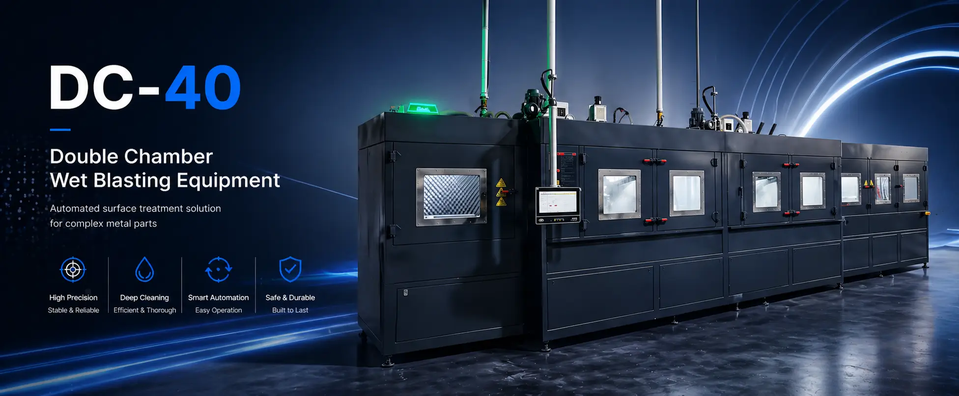
For moderate batch work, a [SC-40 single-chamber cabinet] may still be the right answer if takt is forgiving and part families change frequently. When output increases or loading and blasting must overlap, a [DC-40 double-chamber blasting system] may be evaluated if a cycle study confirms a reduction in idle time for the actual production workflow.
Matching Geometry to Machine Configuration
Part geometry strongly influences equipment choice. Flat components may fit conveyor or plate-specific systems, while rotationally symmetric bars, complex 3D parts, or single-piece fixtures may need more specialized handling. Inline success depends on keeping the part stable and accessible to the nozzles without overcomplicating motion.
| Configuration / Model Tier | Target Production Scale | Workpiece Size Range | Precision Level | Recommended Applications |
|---|---|---|---|---|
| 1. Bench validation unit | Lab trials and sample work | Very small parts | Moderate | Initial process screening and abrasive selection |
| 2. R&D robotic cell | Development and flexible trials | Small precision parts | High | Recipe validation, motion studies, sample testing |
| 3. Standard batch cabinet | Low to medium batch production | Small to medium parts | High | Routine deburring and matte finishing |
| 4. Single-piece dedicated system | Repetitive individual-part flow | Medium parts | High | One-part-per-cycle blasting with stable fixturing |
| 5. Servo multi-axis wet blasting | Precision engineered parts | Small to medium complex parts | Very high | Complex geometry, selective treatment, controlled edge prep |
| 6. Plate-shaped inline system | Continuous flat-part production | Flat or plate-like parts | High | Panels, plates, housings, broad-face pretreatment |
| 7. Double-chamber transfer system | Higher-throughput repetitive production | Small to medium repeat parts | High | Overlapped load/blast/unload sequencing |
| 8. Full inline integrated line | Medium to high automated output | Application-specific | High and traceable | Pretreatment, deburring, or finishing within linked production cells |
In practice, the best inline choice is rarely the largest system on offer. It is the one that aligns blast energy, part orientation, maintenance effort, and takt discipline. A smaller dedicated transfer system may outperform a larger generic line if it matches the part family more closely.
Cost, Lead Time and ROI Considerations
The price of an inline wet blasting system is driven primarily by process architecture, not by blasting alone. A basic chamber-transfer machine and a fully integrated conveyorized line both use slurry, compressed air, and recovery loops, but the second requires much more engineering around material handling, controls, guarding, and synchronization with adjacent equipment.
Automation level is a major cost factor. The more a system must do automatically—indexing, part detection, nozzle motion, recipe switching, load transfer, sludge management, and alarm handling—the more the control system and mechanical layout matter. That is especially true when the blasting line must communicate with robots, washers, dryers, or MES-level production logic.
Abrasive management is another pricing driver that buyers sometimes underestimate. Inline systems process more continuous volume, so the stability of circulation, settling, waste discharge, and contamination control becomes more important. Better slurry management generally costs more up front, but it often reduces instability, rework, and maintenance stoppages later.
Dust and mist control also influence the final project value. Wet blasting suppresses dry dust, yet a production line still needs well-designed extraction to control water mist, sightline loss, and moisture migration. If the line feeds directly into drying or coating, additional separation or handling stages may be justified.
Lead time should be viewed as typical and project-specific rather than fixed. Standard chamber-based systems with limited customization are normally faster than full custom inline lines. Lead time extends when the project includes conveyor design, custom fixtures, multi-axis programming, sample qualification, unusual utility standards, or validation against multiple part families.
ROI in inline wet blasting is usually built from several small gains rather than a single dramatic number. One gain may come from reducing manual deburring labor. Another may come from more stable coating adhesion because pretreatment is consistent. Others may come from lower rework, fewer cosmetic rejects, improved edge quality on cutting tools, or reduced variability between shifts.
The strongest ROI cases tend to share four characteristics. First, the existing manual or semi-manual process is labor-heavy. Second, surface quality has a direct link to downstream performance or scrap. Third, production volume is high enough that handling reduction matters. Fourth, the part family is stable enough that the inline system can run with limited changeover disruption.
When those conditions are present, an inline wet blasting system is less a stand-alone machine purchase than a manufacturing-efficiency project. The business case should therefore compare total process cost, quality loss, and throughput stability—not only quoted capital cost.
Why Choose DasiAuto?
Established in 2012, DasiAuto develops and manufactures wet blasting equipment for industrial surface treatment. The company brings together equipment engineering, abrasive media, and application development, as described in About DasiAuto.
Application testing and process development help evaluate abrasive media and treatment settings before the equipment configuration is defined. Equipment engineering can bring together the blasting system, fixtures, automation, and part handling around the application.
Suitability for a particular material, geometry, finish, or dimensional requirement needs to be established through representative sample testing. DasiAuto supports installation, operator training, and ongoing technical support through the production workflow.
FAQ
Is an Inline Wet Blasting System Suitable for Small Batches, or Only for High-Volume Production?
It is most efficient when part flow is repetitive, but it is not limited to very high volumes. Small-to-medium batch programs can still justify an inline wet blasting system if the parts are consistent, the finish requirement is strict, and manual handling is causing variation. The key is whether the production logic benefits from fixed presentation and repeat cycle timing.
Can Sample Testing Be Done Before Finalizing the Inline Wet Blasting System Layout?
Yes, and in many cases it should be done first. Trial processing helps define abrasive grade, pressure window, nozzle arrangement, dwell time, and whether the parts need fixtures, rotation, or indexed stops. That work reduces the risk of overengineering or underengineering the final line.
What Information Should a Buyer Prepare for an Inline Wet Blasting Quotation?
Part drawings, material type, dimensions, target finish, current process, expected throughput, and the intended place in the production line are the most useful inputs. It also helps to define whether the system must connect to washing, drying, coating, robots, or inspection equipment. Without that information, an inline concept may look viable on paper but miss the real takt or handling constraints.
How Complex Is Installation and Commissioning for an Inline Wet Blasting System?
It is typically more involved than installing a stand-alone cabinet because line integration, utilities, safety interlocks, drainage, and downstream coordination all matter. Commissioning should verify not only that the blasting module runs, but also that it synchronizes correctly with conveyors, fixtures, and adjacent equipment. Process validation on production parts is usually the decisive step.
What Consumables and Spare Parts Should Be Planned From the Start?
Most projects should budget for blasting media, nozzles, hoses, seals, window-protection items, and wear components in pumps or slurry circuits. For inline systems, maintenance planning should also cover sediment removal, filter or mist-collection service, and any conveyor-contact wear points. A stable spare-parts plan supports uptime just as much as the original machine design.
How Should After-Sales Support Be Evaluated for an Inline Wet Blasting System?
Warranty matters, but it is only one part of the evaluation. Buyers should look at training, remote troubleshooting, spare-parts response, abrasive resupply, and the supplier’s ability to refine recipes after startup. For an inline wet blasting system, good after-sales support is often tied directly to line stability, because even a small process drift can affect multiple downstream operations.