
Quick Answer
A wet blasting machine OEM is the right fit when you need more than a standard cabinet and instead require process-matched design, repeatable finishing results, and integration support across abrasive selection, fixtures, controls, and after-sales service. In industrial surface treatment, an OEM-capable supplier typically helps define the slurry circuit, pressure-control logic, nozzle motion, recovery loop, and enclosure layout for your part family. That matters most in precision deburring, edge honing, coating pretreatment, additive-manufactured parts, and batch production where consistency is more valuable than raw blasting force.
| Core Factor | Typical Conclusion |
|---|---|
| Process type | Wet abrasive blasting using water + media slurry accelerated by compressed air |
| Best OEM value | Process customization, fixture design, controls integration, and validation support |
| Dust behavior | Very low airborne dust compared with dry blasting |
| Precision potential | High when pressure, slurry concentration, and motion are recipe-controlled |
| Typical applications | Edge honing, burr removal, scale cleaning, coating pretreatment, AM post-processing |
| Typical lead-time band | Standard systems are usually faster; customized automation projects take longer |
What Is Wet Blasting Machine OEM
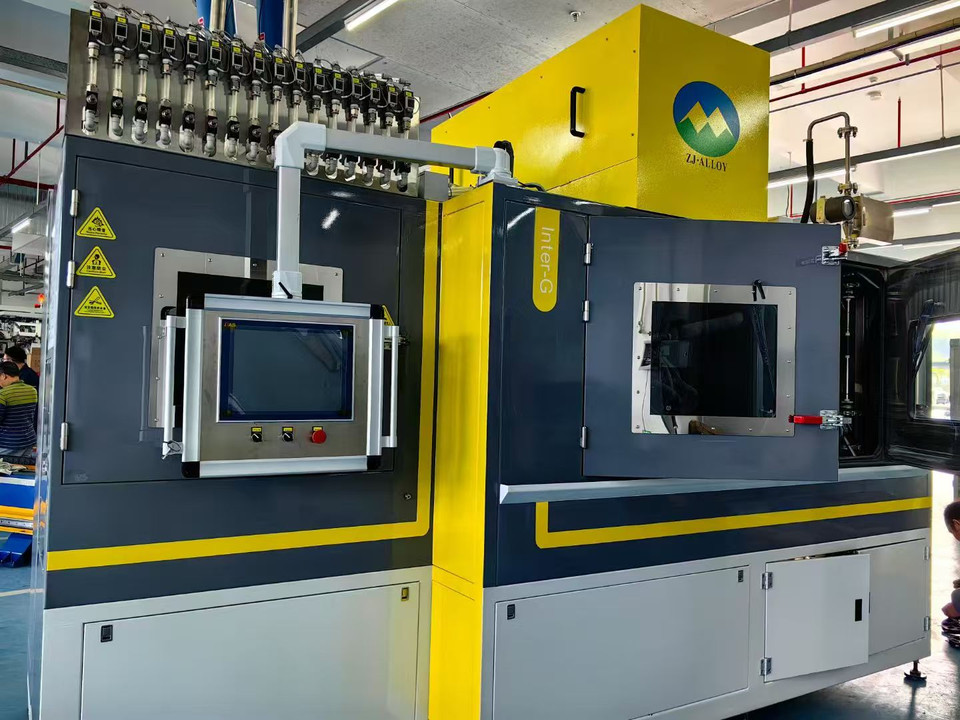
In this context, “wet blasting machine OEM” refers to an original equipment manufacturer that designs and builds wet blasting systems for industrial users, often with a higher degree of customization than an off-the-shelf machine reseller. The OEM role usually includes process engineering, equipment design, controls selection, fixture development, manufacturing, testing, and implementation support. For buyers, that distinction matters because wet blasting performance depends heavily on how the machine is matched to the workpiece, abrasive, target finish, and production rhythm.
Technically, wet blasting belongs to the broader field of abrasive surface treatment. The process suspends blasting media in water to form a slurry, then accelerates that slurry with compressed air toward the workpiece. Compared with dry blasting, the water phase changes the process behavior in several useful ways: it suppresses airborne dust, cushions impact, helps manage heat at the contact zone, and often creates a finer, more even surface texture. General industrial definitions of blasting and media propulsion are consistent with the background described in abrasive blasting terminology.
An OEM in this field is not just selling a chamber and a pump. A capable supplier is expected to understand how slurry density interacts with nozzle wear, how stand-off distance affects finish uniformity, how recovery design influences media stability, and how recipe control affects lot-to-lot consistency. That becomes especially important in applications such as carbide tool edge preparation, cosmetic metal finishing, burr removal from intricate machined parts, and pretreatment before coating.
The main technical appeal of a wet blasting OEM approach lies in four recurring advantages. First, dust-free operation is not literally absolute, but wet blasting greatly reduces dry airborne particulate compared with conventional dry abrasive blasting. Second, the water film between abrasive and substrate can reduce the chance of grit lodging in sensitive surfaces. Third, the cushioned micro-erosion effect often produces a more even matte finish or edge treatment. Fourth, process repeatability improves when pressure, slurry concentration, motion, and cycle time are engineered as a system rather than improvised at the machine.
From a procurement perspective, “OEM” also implies ownership of design decisions. A real manufacturer can usually adapt cabinet dimensions, rotary tables, servo axes, nozzle arrangement, sedimentation design, control logic, and loading method to suit the application. That is very different from buying a standard machine and then attempting to force it into a process window it was never designed to hold.
For industrial buyers, the practical question is not whether an OEM-built wet blasting machine exists, but whether the OEM can translate a surface target into a stable production process. If the answer depends on sample testing, recipe development, and fixture validation, then OEM capability is often more important than the basic machine category.
How Does Wet Blasting Machine OEM Work
A wet blasting machine built by an OEM works through an integrated sequence of slurry preparation, media acceleration, controlled workpiece exposure, and recovery. Although the basic principle is straightforward, the engineering value lies in how those subsystems are tuned to one another. In production environments, small mismatches between slurry concentration, air demand, nozzle geometry, and recovery efficiency can create major swings in finish quality.
Slurry System Design
The process begins with water and abrasive media mixed into a circulating slurry. Depending on the application, the media may be selected for finer edge preparation, moderate deburring, cosmetic texturing, or more active cleaning. Agitation inside the tank keeps solids suspended long enough to maintain stable blasting conditions over a full production cycle.
OEM design matters here because a poorly designed tank or recirculation path can allow uneven settling, dead zones, or fluctuating solids concentration. Those issues show up as inconsistent removal rates and changing surface texture. In better systems, the slurry loop is engineered to maintain homogeneous feed to the blast circuit and minimize abrupt concentration drift.
Compressed Air and Nozzle Acceleration
Once the slurry is mixed, compressed air accelerates it through the blasting nozzle. The nozzle transforms line pressure into particle velocity and pattern shape, which directly affects removal intensity and finish uniformity. The same nominal pressure can behave very differently depending on nozzle bore, wear state, stand-off distance, and impact angle.
For OEM-built equipment, nozzle selection is not a trivial accessory choice. It has to match the abrasive size, slurry flow, workpiece geometry, and target cycle time. Precision processes often use moderate pressure with more disciplined path control rather than aggressive pressure alone, because excessive impact can alter geometry or over-round critical edges.
Workpiece Motion and Exposure Control
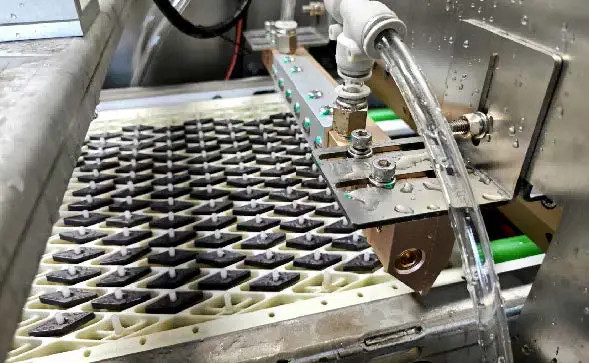
The workpiece may be fixed, indexed, rotated, or presented through servo-controlled motion axes. The OEM decision here depends on the product family. Small precision parts may need rotary fixtures or turntables to expose all sides evenly. Complex parts may require multi-axis nozzle motion. Flat plates, rods, and single-piece heavy parts often benefit from dedicated loading and presentation systems tailored to geometry.
For example, a standard batch cabinet such as the SC-40 single-chamber wet blasting cabinet may be evaluated for repeat production scenarios where batch consistency matters more than fully continuous flow, subject to representative sample testing and a validated handling cycle. By contrast, a complex-geometry process may need coordinated nozzle travel similar to the approach represented by complex-part wet blasting equipment .
Recovery, Sedimentation, and Mist Management
After striking the workpiece, the spent slurry drains back into the machine. Reusable abrasive remains in circulation, while broken media, fines, and removed contaminants gradually separate out through sedimentation and waste handling. This closed-loop slurry recovery is one of the defining differences between a production-oriented wet blasting system and a simple wash cabinet with abrasive added.
Mist management is also important. Wet blasting suppresses dry dust, but it still creates moisture-laden air and fine suspended particles inside the enclosure. OEM systems therefore include extraction or dust-collection arrangements that improve visibility, reduce water mist carryover, and help maintain a cleaner surrounding workspace.
Pressure Control and Recipe Management
Pressure stability is central to repeatable blasting. If line pressure drifts during a cycle, the result may be a visibly different finish, a shifted edge radius, or incomplete burr removal. OEM-grade equipment often uses PID-based control to stabilize process pressure and ensure the machine operates at the intended setpoint instead of fluctuating around it.
The best systems also use HMI recipe management. That allows different products to store their own pressure, time, table speed, motion path, slurry concentration, and maintenance prompts. In multi-part factories, recipe management reduces setup variability between operators and shortens changeovers.
In precision wet blasting, the machine is only as repeatable as its weakest link in pressure control, slurry stability, fixture design, or recovery management.
| Process Parameter | Typical Range or Practice | Why It Matters |
|---|---|---|
| Working pressure | Typically set from lower to moderate industrial blasting levels, depending on substrate and finish target | Controls impact energy, removal rate, and edge conditioning effect |
| Slurry concentration | Commonly maintained within a defined wt% or volume band for each recipe | Stabilizes finish quality, cutting action, and media efficiency |
| Abrasive particle size | Fine to medium PSD selected by application | Influences roughness, burr removal behavior, and edge radius outcome |
| Air flow demand | Sized to nozzle count, nozzle diameter, and duty cycle | Supports consistent acceleration and reduces pressure drop during operation |
| Media consumption rate | Varies by abrasive hardness, recycling efficiency, and contamination level | Affects operating cost, maintenance interval, and finish stability |
| Control system | PLC/HMI with pressure feedback, recipe storage, and alarm logic | Improves repeatability, traceability, and changeover discipline |
Wet Blasting Machine OEM vs Dry Blasting vs Other Methods
Comparing a wet blasting machine OEM solution with other finishing methods requires looking beyond headline claims about speed or cleanliness. Each process occupies a different place in the production chain. Wet blasting is often selected when manufacturers need a controlled surface state, low dust, and relatively gentle but effective abrasive action across complex or high-value parts.
Dry blasting remains useful for aggressive cleaning, scale removal, and roughening, especially where dust burden is acceptable and the finish target is less sensitive. Shot peening is different again: it is primarily used to induce beneficial compressive stress rather than to deburr or create a cosmetic matte surface, and its process logic is usually closer to fatigue-performance engineering than general finishing. Vibratory finishing is strong in bulk smoothing and edge softening, but it is less selective when only certain features should be treated.
This is why the wet blasting OEM conversation often includes application engineering. The supplier is not only choosing a machine format, but also identifying whether wet blasting should replace manual deburring, supplement machining, precede coating, or coexist with peening and tumbling operations. Surface-preparation frameworks from AMPP surface preparation standards are often relevant when buyers evaluate downstream coating performance and cleanliness requirements.
| Evaluation Dimension | Wet Blasting | Dry Blasting | Shot Peening | Vibratory Finishing |
|---|---|---|---|---|
| Airborne dust | Low due to water-suspended media | High relative to wet blasting | Moderate, depending on media and enclosure | Low external dust but uses compounds and media systems |
| Finish uniformity | High for controlled matte finishing and precision conditioning | Moderate to high, often more aggressive | Secondary to stress-introduction objective | Good for batch smoothing, less selective |
| Media embedding risk | Lower on many sensitive surfaces because of water film effect | Higher on some soft or coated surfaces | Depends on media/substrate combination | Different mechanism; not usually framed this way |
| Local feature targeting | Strong with fixturing and nozzle path control | Strong, but more operator-dependent if manual | Strong in defined peening zones | Weaker for selective feature treatment |
| Repeatability | High when recipe-controlled | Variable if manual, better if automated | High in qualified peening processes | Moderate to high in stable batch conditions |
| Environmental housekeeping | Favorable versus dry dust systems | Greater dust collection and cleaning burden | Controlled media handling required | Slurry/compound management required |
| Typical best use | Deburring, edge prep, pretreatment, AM finishing, cosmetic texture | Heavy cleaning, aggressive rust or scale removal | Fatigue-life enhancement | Bulk smoothing and general edge softening |
Key Specifications to Evaluate Before Buying
Choosing a wet blasting machine OEM should begin with the process window rather than a brochure model number. Buyers often focus first on cabinet size or nozzle count, but the more decisive specifications are pressure stability, slurry consistency, motion control, fixture logic, and maintainability over long shifts. If those elements are weak, a larger or more automated machine may still fail to deliver the required surface result.
Wet Blasting Pressure and Slurry Stability
Pressure should be assessed in terms of controllability, not just maximum range. For edge honing, cosmetic finishing, or selective deburring, stable pressure at the chosen setpoint is more valuable than extreme blasting force. Slurry concentration control is equally important, because even well-regulated air pressure cannot compensate for a drifting abrasive load.
Motion Accuracy and Surface Treatment Precision
When the process depends on precise nozzle positioning, servo-driven axis capability becomes a serious buying criterion. The positioning performance of the proposed servo X/Y/Z linkage should be verified where small changes in stand-off distance or path position affect the final surface state. Buyers should ask how motion accuracy is defined, how it is maintained over time, and how it relates to actual process repeatability on the part.
Throughput, Footprint, and Recipe Control
Production planning should consider not only cycle time, but also loading method, fixture density, drainage time, visibility, and cleaning between batches. HMI recipe management is worth scrutinizing because multi-SKU production environments often fail at changeover discipline before they fail at machine capacity. Permission levels, alarm history, and recipe backup functions are therefore practical production features, not software decoration.
Utilities, Waste Handling, and Safety
An OEM supplier should define the compressed-air demand, electrical requirements, water management approach, drainage, and waste-sand discharge method clearly during quotation. Automatic sedimentation and one-click discharge can reduce maintenance burden, but buyers should still ask how often cleaning is required and how broken media is separated from reusable slurry. Safety review should cover interlocks, enclosure sealing, operator access, visibility, and any mist-extraction or filtration provisions.
A useful procurement checklist includes the following points:
- Confirm the exact substrate family: carbide, steel, stainless steel, aluminum, titanium, glass, or mixed materials.
- Define the surface outcome in measurable terms: burr removal, edge radius, matte texture, oxide removal, or coating anchor profile.
- Ask how slurry concentration is controlled, corrected, and verified during production.
- Review nozzle material, wear life, access, and replacement procedure.
- Check whether the machine uses fixed nozzles, indexing, turntables, or servo X/Y/Z motion.
- Evaluate HMI recipe storage, permission hierarchy, and process traceability.
- Confirm mist-control design and operator visibility inside the chamber.
- Review waste-sand sedimentation, discharge ergonomics, and maintenance interval.
- Ask whether sample testing includes abrasive selection and fixture validation.
- Clarify whether installation, commissioning, and operator training are included in project scope.
Applications Across Industries
A wet blasting machine OEM serves many industries because the core process is highly adaptable. By changing media size, slurry concentration, nozzle strategy, fixture style, and automation level, the same technical platform can move from very fine cutting-tool edge preparation to more general deburring, cleaning, and coating pretreatment. The common value is controlled abrasive action with good repeatability and lower dust exposure than dry blasting.
In toolmaking, one of the strongest examples is edge honing of cutting tools, where the target is a controlled K-factor or edge condition rather than random stock removal. In metalworking more broadly, OEM-designed systems are widely used for burr removing of metal parts where fragile edges or intersecting features make manual finishing inconsistent. For pretreatment lines, wet blasting is also used upstream of coating when cleanliness and uniform texture affect downstream adhesion, which is why some manufacturers evaluate integrated routes such as coating pretreatment wet blasting.
AM components, glass parts, and 3C housings represent another cluster of applications. These parts often require fine cosmetic control, gentle surface smoothing, or treatment of complex geometry that does not respond well to simple brushing or bulk tumbling. An OEM approach becomes especially useful when those parts vary in geometry but still need a repeatable finish standard across lots.
| Application Type | Target Industry | Workpiece Example | Process Benefit |
|---|---|---|---|
| Edge honing | Carbide cutting tools | Inserts, drills, end mills | Controlled edge preparation and more consistent edge condition |
| Burr removal | Precision metalworking | Machined or stamped metal components | Selective deburring with less operator variability |
| Scale removal | Forging and steel processing | Bars, forgings, heat-treated parts | Oxide removal with improved surface uniformity |
| Pretreatment before coating | Automotive, hardware, appliances | Brackets, housings, fabricated parts | Cleaner substrate and more stable coating adhesion |
| AM post-processing | Additive manufacturing | 3D-printed metal components | Surface smoothing and removal of loosely attached residue |
| Surface conditioning / light peening | General engineering | Functional metal parts | Controlled surface treatment where gentler impact is useful |
| Glass frosting | Glass processing | Decorative or functional glass parts | Even matte appearance with lower dry-dust burden |
| 3C device finishing | Electronics supply chain | Casings, frames, precision shells | Fine texture control and cosmetic uniformity |
From a production-engineering perspective, the most successful applications are usually those where the desired result can be specified clearly. If the requirement is “remove any visible burr” or “create a consistent matte finish,” the OEM still needs to translate that into process variables such as abrasive grade, pressure band, stand-off distance, and cycle time. The more clearly that endpoint is defined, the more successful the machine selection tends to be.
Equipment Selection Guide
A useful way to evaluate a wet blasting machine OEM is to match the supplier’s equipment family to your production logic. Not every buyer needs a high-automation cell, and not every part family can be handled well in a simple standard cabinet. The right selection typically depends on geometry complexity, batch size, takt time, and how much variation exists between part models.
For R&D or sample validation, a robot-loaded or flexible laboratory system is often the best entry point because it allows rapid parameter development before committing to a dedicated line. Where output is steady and part variety is moderate, a production batch cabinet may offer the best balance of cost and repeatability. High-throughput factories, by contrast, may prefer double-chamber or line-integrated configurations that minimize idle loading time.
The selection exercise should also consider presentation method. Flat plate parts, long cylindrical stock, single-piece heavy components, and complex multi-face geometries typically require different equipment logic even when the blasting medium is the same. An OEM that offers several machine architectures is often better positioned to recommend the appropriate format instead of forcing one standard platform across unrelated applications.
| Configuration / Model Tier | Target Production Scale | Workpiece Size Range | Precision Level | Recommended Applications |
|---|---|---|---|---|
| 1. R&D lab-scale cell | Process development, trials, small batches | Small precision parts | Very high flexibility | Sample testing, recipe development, new product validation |
| 2. Compact cabinet system | Low-volume shop use | Small parts | Moderate to high | Manual-assisted deburring and maintenance finishing |
| 3. Standard single-chamber production cabinet | Batch production | Small to medium parts | High | General deburring, edge prep, cosmetic surface finishing |
| 4. Single-piece dedicated system | Stable processing of one part per cycle | Medium to large single parts | High | Individual-part blasting with controlled coverage |
| 5. Servo multi-axis system | Precision engineered parts | Small to medium complex parts | Very high | Complex geometry, selective feature treatment, edge conditioning |
| 6. Plate-part processing system | Repetitive flat components | Flat or plate-shaped parts | High | Sheet-metal and plate-surface treatment |
| 7. Double-chamber throughput system | Higher-volume production | Small to medium repeat parts | High | Reduced idle time, continuous batch flow |
| 8. Inline-integrated process cell | Automated production lines | Application-specific | High and traceable | Pretreatment, linked finishing lines, serialized production |
When reviewing these tiers, buyers should ask whether the OEM can demonstrate successful parameter transfer from trial stage to production stage. A machine that performs well in a lab test but cannot hold concentration, loading logic, or maintenance rhythm in production may not deliver the expected ROI. That is why selection should combine machine type, process validation, and long-run maintainability.
Cost, Lead Time and ROI Considerations
The cost structure of a wet blasting machine OEM project usually has two layers: platform cost and application cost. Platform cost covers the chamber, slurry loop, pressure-control hardware, recovery system, controls, and safety features. Application cost reflects customization such as fixtures, servo motion, robot handling, recipe development, special nozzles, utility adaptations, and any integration needed with upstream or downstream processes.
Standard cabinets generally cost less and move faster through engineering than specialized automation cells. Once a project includes multi-axis motion, nonstandard work envelopes, unique part nests, or coordinated pretreatment steps, the cost profile changes because the supplier is no longer shipping a standard machine but building a process-specific solution. This is where OEM capability has real value, but it also explains why quotations can vary significantly for apparently similar blasting tasks.
Lead time should be treated as a typical project band rather than a fixed promise. Standard batch systems are usually the shortest path because the mechanical platform is already defined. Dedicated fixtures, customer-specific electrical requirements, automation interfaces, validation testing, and export packaging all extend the timeline. The most useful way to discuss lead time is by stage: engineering confirmation, manufacturing, factory test, shipping, installation, commissioning, and process stabilization.
ROI should not be reduced to machine price divided by labor savings. In surface treatment, the return often comes from several smaller gains happening at the same time. Manual deburring hours may fall, but so may rework, scrap, finish inconsistency, abrasive waste, and downstream coating defects. For cutting tools, the economic gain may show up in more stable edge quality and reduced part rejection. For coating pretreatment, the gain may come from more reliable adhesion and fewer repaint events.
A good ROI review therefore tracks at least five variables: labor intensity, cycle repeatability, reject rate, consumable efficiency, and maintenance downtime. In some facilities, replacing manual work is the main value driver. In others, the machine pays for itself by producing a more controlled surface state that reduces failures later in the production chain.
NIST-style manufacturing guidance often emphasizes process capability and repeatability as core contributors to production economics, which is consistent with the broader quality-engineering perspective described by NIST manufacturing resources. In practice, buyers get the clearest ROI picture when they run a sample lot, document the baseline method, and compare finish quality, time per part, and rework burden against the proposed wet blasting route.
Why Choose DasiAuto?
Established in 2012, DasiAuto develops and manufactures wet blasting equipment for industrial surface treatment. The company brings together equipment engineering, abrasive media, and application development, as described in About DasiAuto.
Application testing and process development help evaluate abrasive media and treatment settings before the equipment configuration is defined. Equipment engineering can bring together the blasting system, fixtures, automation, and part handling around the application.
Suitability for a particular material, geometry, finish, or dimensional requirement needs to be established through representative sample testing. DasiAuto supports installation, operator training, and ongoing technical support through the production workflow.
FAQ
What Does an OEM Actually Provide Beyond a Standard Wet Blasting Cabinet?
An OEM typically provides process engineering, machine design, fixture development, controls configuration, and validation support rather than only the hardware. That matters when the part geometry, finish target, or production volume requires more than a generic cabinet setup. In wet blasting, repeatability usually depends on the full system design, not on the cabinet alone.
Is There Usually an MOQ for a Wet Blasting Machine OEM Project?
For capital equipment, MOQ is usually less important than project scope. Many OEMs can supply a single machine if the application is clearly defined and technically feasible. The more relevant question is whether the supplier can support testing, fixture design, and commissioning for your required output.
Can the OEM Run Sample Testing Before Finalizing the Machine Configuration?
Yes, and in many cases it should be considered essential. Sample testing helps confirm abrasive selection, cycle time, burr-removal effectiveness, finish quality, and whether the proposed machine architecture is appropriate. It also reduces the risk of over-specifying or under-specifying automation.
How Long Does Installation and Operator Training Usually Take?
That depends on system complexity, site readiness, and whether the machine is standard or customized. A simpler cabinet generally installs faster than a multi-axis or line-integrated system, but operator training should still cover slurry management, recipe selection, daily checks, and wear-part replacement. Commissioning often continues beyond physical installation until stable process output is achieved.
What Spare Parts and Consumables Should Buyers Plan For?
Wet blasting systems usually require planning for nozzles, seals, hoses, wear liners, pump or delivery components, and matched abrasive replenishment. Buyers should also ask about sedimentation cleanout intervals, viewing-window maintenance, and any filtration or mist-control components that need routine replacement. A realistic spare-parts plan reduces unexpected downtime after startup.
How Should Buyers Evaluate Warranty and After-Sales Support From a Wet Blasting Machine OEM?
The strongest evaluation method is to look beyond the warranty period itself and examine the supplier’s service scope. Buyers should clarify whether support includes remote troubleshooting, spare-part supply, process optimization, operator retraining, and commissioning follow-up if part requirements change. In a wet blasting process, after-sales capability matters because stable performance depends on maintaining both the machine and the process window.