
Quick Answer
A turntable wet blasting machine is usually the right choice when parts need consistent all-around coverage, controlled deburring, low-dust processing, and repeatable surface finishes at batch-production scale. Compared with manual blasting or dry blasting, a rotary table layout stabilizes stand-off distance, exposure time, and nozzle path, which helps maintain part-to-part consistency. It is especially effective for carbide tools, precision metal parts, coating pretreatment, additive-manufactured components, and cosmetic finishing where surface control matters as much as throughput.
| Core Factor | Typical Conclusion |
|---|---|
| Process type | Automated wet abrasive blasting with rotary indexing or continuous turntable motion |
| Typical pressure band | Commonly set in a moderate industrial range, depending on material and finish target |
| Precision potential | High repeatability when nozzle motion, turntable speed, and slurry concentration are controlled |
| Dust behavior | Very low airborne dust because abrasive is suspended in water |
| Best-fit applications | Deburring, edge honing, scale removal, coating pretreatment, AM post-processing, cosmetic finishing |
| Typical project timeline | Usually shorter for standard cabinets, longer for custom automation or multi-axis systems |
What Is Turntable Wet Blasting Machine
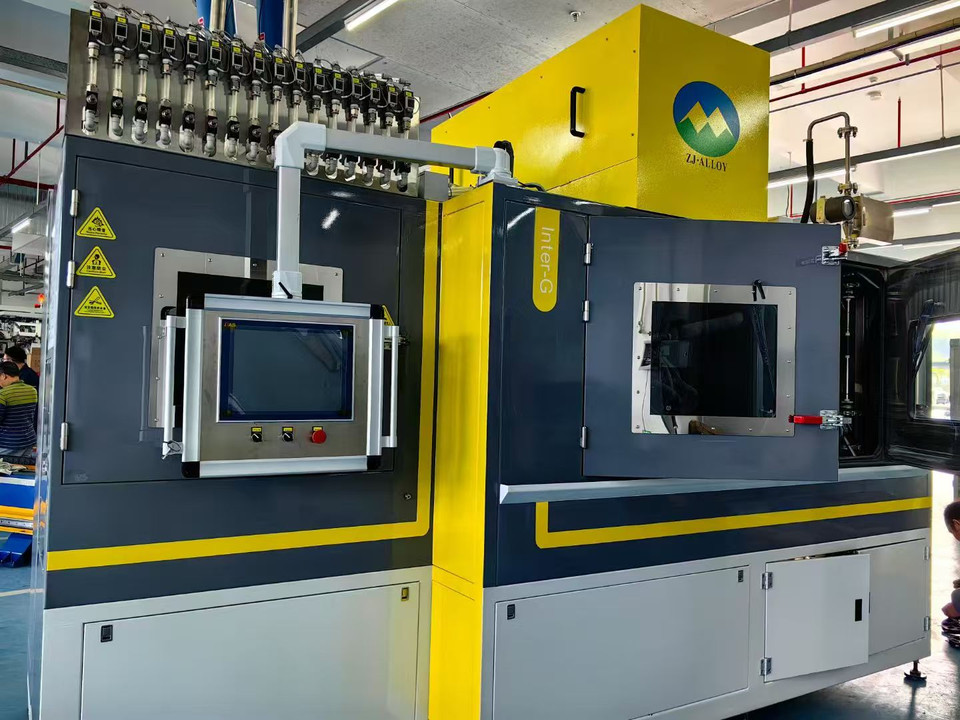
A turntable wet blasting machine is an enclosed abrasive surface-treatment system in which workpieces are mounted on a rotating table and processed by one or more slurry-blasting nozzles. The blasting media is suspended in water, then accelerated by compressed air or pressure-fed slurry delivery so the surface is cleaned, textured, deburred, or edge-conditioned in a controlled way. The turntable architecture is important because it gives the process a predictable rotational path, which is often easier to automate than hand-held or free-fixture blasting.
Within the broader abrasive blasting process family, this equipment belongs to wet blasting, also called wet sandblasting, slurry blasting, or vapor blasting in some industrial contexts. The process family differs from dry blasting because the water phase suppresses dust, cushions abrasive impact, and helps reduce random media ricochet. In production terms, that usually translates into cleaner operator conditions and better finish control on sensitive parts.
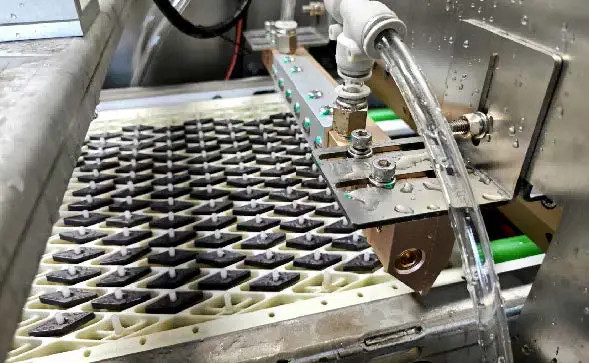
The turntable layout is widely used where several small or medium components must be processed in a repeatable batch. Parts can be fixed individually around the table perimeter, placed on dedicated nests, or mounted on multi-station carriers. As the table rotates, each part sees a repeatable exposure profile relative to the nozzle angle, standoff distance, and dwell time.
The core selling points are practical rather than theoretical. First, wet blasting reduces airborne dust substantially because the water phase captures fine particles before they disperse. Second, the process is well suited to precision finishing because the slurry cushions impact energy, often helping achieve a more uniform finish than aggressive dry blasting on delicate geometries. Third, water-assisted impact can reduce the risk of abrasive becoming trapped in softer or more complex surfaces, which matters in downstream cleaning, coating, and assembly.
Turntable systems also fit well into recipe-based manufacturing. When the table speed, nozzle path, slurry concentration, pressure, and blasting duration are programmed, the process becomes easier to reproduce across shifts and product families. That is why rotary wet blasting is often chosen for applications that sit between simple manual cabinets and fully continuous inline lines: it balances automation, controllability, and footprint.
Another reason buyers search specifically for a turntable format is fixture simplicity. In many cases, one rotary platen can present multiple part faces to the nozzle without requiring a robot for every movement. That can lower complexity while still supporting stable processing windows. For plants moving from manual deburring or inconsistent dry blasting, the step up in process control is often more important than raw blasting intensity.
How Does Turntable Wet Blasting Machine Work
The operating principle combines slurry preparation, compressed-air acceleration, rotational part presentation, and closed-loop recovery. Instead of feeding dry grit through an air stream alone, the machine suspends abrasive particles in water inside a mixing or agitation tank. That suspension is then delivered to the blast circuit and directed toward the workpiece through purpose-designed nozzles.
Slurry Formation and Delivery
The slurry loop starts with water plus a selected abrasive grade. Depending on the target finish, the media may be relatively fine for edge honing or cosmetic finishing, or somewhat coarser for scale removal and heavier deburring. Agitation keeps the particles from settling too quickly, while concentration control maintains a stable abrasive-to-water ratio over time.
In a turntable wet blasting machine, stable slurry concentration is essential because rotational consistency is only valuable if the abrasive load is also stable. If the mixture becomes too lean, surface action weakens and cycle time drifts. If it becomes too rich, nozzle wear, media breakdown, and finish variability can increase.
Compressed Air Acceleration and Nozzle Action
Compressed air provides the kinetic energy that accelerates the slurry through the nozzle. The nozzle geometry affects velocity, spray pattern, and impact distribution. In practical terms, pressure, nozzle diameter, stand-off distance, and impingement angle work together to define the finish result.
For delicate precision work, operators often prefer moderate pressure and tighter control of dwell time rather than simply raising blasting force. That is particularly true for carbide edges, thin-walled metal parts, or cosmetic surfaces where too much energy can round features excessively or produce unwanted texture. A properly designed turntable helps by keeping each part within a narrow process envelope during rotation.
Rotary Exposure and Motion Coordination
The defining feature of the machine is the turntable itself. The workpieces rotate past one or more nozzles, or the nozzles traverse while the table rotates. Some systems use a simple constant-speed platter; others use indexing stations, servo positioning, or synchronized X/Y/Z nozzle motion for more complex coverage.
This coordination matters for uniformity. A fixed nozzle on a stable rotating table can produce very repeatable outer-surface treatment on axisymmetric or regularly shaped parts. For more demanding work, multi-axis motion is added so the slurry stream follows critical edges, pockets, or profiles. In higher-end systems, closed-loop control helps maintain blasting pressure while recipes store process settings by part number.
In precision wet blasting, consistency usually depends less on maximum pressure than on how tightly pressure, slurry concentration, nozzle path, and exposure time are held together.
Closed-Loop Recovery, Sedimentation, and Water Mist Control
After impact, the slurry falls into the cabinet sump and returns to the recovery loop. Usable abrasive can be recirculated, while broken media, fines, and process residue are separated through sedimentation and waste handling. In industrial systems, automatic waste-sand sedimentation and one-click discharge reduce manual cleaning and help stabilize process quality between maintenance intervals.
Although wet blasting drastically cuts dry dust, it still generates mist and fine suspended matter. That is why machines typically include extraction and mist-control devices rather than a conventional dry dust collector alone. The objective is a cleaner enclosure atmosphere, better visibility, and reduced carryover into surrounding plant areas.
PID Pressure Regulation and Recipe Control
One of the biggest differentiators between basic and production-grade machines is process regulation. PID pressure control stabilizes blasting pressure against normal fluctuations in supply or loop conditions. This matters because small pressure drift can change edge radius, deburring intensity, or cosmetic texture. An HMI-based recipe system then stores parameters such as pressure, table speed, nozzle path, cycle time, and alarm thresholds so different part families can be run consistently.
| Process Parameter | Typical Range or Practice | Why It Matters |
|---|---|---|
| Working pressure | Typically moderate wet-blasting pressure, adjusted by material and finish target | Controls impact energy, removal rate, and edge effect |
| Slurry concentration | Usually maintained within a defined weight or volume band | Affects cutting action, finish stability, and media use |
| Abrasive particle size | Fine to medium PSD, selected by application | Influences roughness, deburring aggressiveness, and edge radius |
| Air flow / nozzle demand | Sized to nozzle count and duty cycle | Determines stable acceleration and process repeatability |
| Media consumption | Varies with abrasive type, recycling efficiency, and breakage rate | Impacts operating cost and maintenance frequency |
| Control system | PLC + HMI recipe management with pressure feedback, often PID-based | Supports repeatability, traceability, and faster changeovers |
Turntable Wet Blasting Machine vs Dry Blasting vs Other Methods
A turntable wet blasting machine is not a universal replacement for every finishing process. It is strongest where manufacturers need controlled surface modification on medium-value or high-value parts, especially when dust reduction and surface consistency matter. To evaluate fit, buyers should compare it not only with dry blasting, but also with processes such as shot peening and vibratory finishing.
Dry blasting remains useful for heavy cleaning and some lower-cost roughening tasks, but it can create more airborne dust and may require more attention to enclosure wear, dust collection, and post-cleaning. Shot peening, by contrast, is not primarily a cleaning or deburring process; it is designed to induce compressive stress for fatigue performance, with methods often governed by peening-specific standards and process controls discussed within ASTM materials standards resources. Vibratory finishing is effective for batch smoothing and edge softening, but it may struggle to target specific local features as precisely as nozzle-based blasting.
The right comparison question is therefore not simply “which process is cheaper?” but “which process creates the required surface state with the least total process risk?” That includes geometry access, cleanliness, operator exposure, repeatability, and compatibility with downstream coating or assembly.
| Evaluation Dimension | Turntable Wet Blasting | Dry Blasting | Shot Peening | Vibratory Finishing |
|---|---|---|---|---|
| Airborne dust generation | Low, because water suppresses dust | High relative to wet blasting | Moderate, depends on media and enclosure | Low external dust, but uses compound/slurry systems |
| Surface finish control | High for precision texture and light material removal | Moderate to high, but often more aggressive | Focused on stress state more than cosmetic finish | Good for general smoothing, less localized control |
| Media embedding risk | Lower on many sensitive surfaces due to water film effect | Higher risk on some softer or coated substrates | Depends on media and substrate | Not a typical concern in the same way |
| Geometry targeting | Good with rotary fixtures and nozzle control | Good, especially manually, but operator-dependent | Good for defined peening zones with dedicated setups | Lower for selectively treating one feature |
| Repeatability | High with recipe control and fixed motion | Variable if manual; better in automated systems | High in qualified peening setups | Moderate to high for bulk finishing |
| Environmental / housekeeping load | Favorable mist-managed process; less dry dust | Heavier dust collection burden | Requires controlled media handling | Requires liquid and compound management |
| Typical use case | Deburring, edge honing, coating prep, AM finishing | Heavy cleaning, roughening, rust or scale removal | Fatigue-life enhancement | Bulk edge softening and cosmetic smoothing |
Key Specifications to Evaluate Before Buying
When buyers ask for quotations, the first mistake is often focusing only on cabinet size and blasting pressure. In practice, the best purchasing decisions come from matching machine dynamics to the part family: geometry, material, finish target, takt time, changeover frequency, and maintenance expectations. The machine should be judged as a process platform, not just a cabinet with nozzles.
Pressure Stability Is More Important Than Peak Pressure
For many precision applications, consistent pressure matters more than the highest possible pressure range. If the process objective is edge preparation, fine deburring, or coating pretreatment, the useful question is whether the machine can hold the chosen setpoint steadily over the entire cycle. That is where PID pressure regulation, reliable air supply design, and a stable slurry loop have direct production value.
Motion Accuracy and Turntable Control
If the machine includes servo nozzle axes or programmable part positioning, motion accuracy becomes a decisive specification. The positioning performance of any proposed servo X/Y/Z linkage should be verified for applications where nozzle path repeatability affects edge radius or selective deburring. Buyers should ask how that accuracy is defined in the control system and how it relates to actual blasting repeatability at the part surface.
Throughput, Fixture Density, and Changeover
Turntable format is attractive because it can raise throughput without necessarily requiring a full inline conveyor. But throughput depends on more than table diameter. The real drivers are how many parts fit per fixture, how uniformly those parts can be exposed during rotation, and how long it takes to load, unload, and clean between recipes.
Utilities, Safety, and Waste Handling
Wet blasting reduces dust, but it does not eliminate infrastructure requirements. Compressed air quality, water management, electrical capacity, and mist extraction all influence uptime and finish consistency. Waste-sand handling should also be reviewed closely, because a machine that is tedious to clean often becomes inconsistent in long production runs.
For general procurement frameworks in industrial finishing and protective coating preparation, buyers often align internal reviews with guidance from AMPP standards programs and supplier-specific validation tests. In real projects, sample processing usually reveals more than a specification sheet alone.
Instead of another comparison table, use this checklist during supplier discussions:
- Confirm the target material set: carbide, tool steel, stainless steel, aluminum alloy, titanium alloy, glass, or mixed families.
- Define the surface objective clearly: deburring, edge honing, matte finish, oxide removal, coating keying, or post-print smoothing.
- Ask whether the turntable is continuous-rotation, indexed, or servo-positioned.
- Verify nozzle count, nozzle material, and access to maintenance points.
- Review HMI recipe storage, permission levels, and alarm logging.
- Check mist control, viewing-window cleaning, and enclosure visibility during operation.
- Ask how slurry concentration is measured, corrected, and recorded.
- Review sedimentation design, waste discharge frequency, and cleaning ergonomics.
- Confirm available fixture concepts for small parts, thin parts, delicate parts, or mixed batches.
- Ask for trial processing that measures finish, edge condition, and cycle time on your actual workpieces.
Applications Across Industries
Turntable wet blasting machines are used across a broad range of sectors because the process can be tuned from gentle cosmetic finishing to more active cleaning and edge conditioning. The common thread is controlled abrasive impact with good repeatability. Where the part family benefits from consistent exposure around multiple faces, the turntable format becomes especially efficient.
In cutting-tool production, one of the most common applications is edge honing of cutting tools, where the aim is to create a controlled edge condition rather than simply remove material. The same principle carries into deburring: a stable rotary presentation helps remove loose burrs while limiting excessive attack on the surrounding surface. For many shops, turntable wet blasting becomes the bridge between manual handwork and full robotic automation.
Coating lines also use wet blasting before painting, phosphating, or other pretreatment stages because a clean, uniform anchor profile can improve downstream consistency. Where the process chain includes both cleaning and conversion steps, a combined route such as coating pretreatment wet blasting may fit better than a standalone cabinet.
| Application Type | Target Industry | Workpiece Example | Process Benefit |
|---|---|---|---|
| Edge honing | Carbide cutting tools | Inserts, drills, end mills | Controlled edge preparation, improved edge consistency |
| Burr removing | Precision metalworking | Stamped or machined metal parts | Selective burr reduction with less manual finishing |
| Scale removal | Steel processing and forgings | Bars, forgings, heat-treated parts | Removes oxide and scale while improving surface uniformity |
| Pretreatment before coating | Automotive, hardware, appliances | Brackets, housings, fabricated components | Improves cleanliness and coating adhesion consistency |
| AM post-processing | Additive manufacturing | Metal printed lattices or complex components | Smooths surface and removes partially attached residues |
| Surface peening / conditioning | General engineering | Springs, functional metal parts | Controlled surface conditioning where gentle impact is preferred |
| Glass frosting | Glass processing | Panels, decorative glass, functional glass parts | Uniform matte texture without aggressive dry dust |
| 3C device finishing | Consumer electronics supply chain | Casings, frames, precision housings | Fine cosmetic texture and smoothness control |
The medical, energy, and aerospace-adjacent supply chains also evaluate these systems, especially for complex metal geometries produced by machining or additive routes. In such cases, buyers tend to prioritize process documentation, recipe repeatability, and finish traceability over simple cycle-speed comparisons.
Another strong use case is selective deburring of intricate parts. A wet blasting process tuned with fine abrasive can target residual burrs at edges, slots, and intersecting holes more gently than some bulk-finishing methods. That is one reason many manufacturers compare a turntable system against manual brushing, thermal deburring, and vibratory finishing during process development.
Equipment Selection Guide
Selecting the right machine starts with the production scenario, not the model name. A laboratory or R&D department may need flexible fixturing and rapid parameter changes, while a high-volume plant may care more about dual-station loading, continuous flow, and maintenance intervals. The turntable concept can be implemented across both ends of that spectrum.
For R&D and sample validation, a flexible platform such as the RB-6 robot-type wet blasting equipment suits applications where engineers are still determining abrasive grade, stand-off distance, and path strategy. For standard batch production, a cabinet format such as the SC-40 single-chamber wet blasting cabinet is often closer to the practical starting point.
If the main challenge is deburring rather than full-surface cosmetic finishing, process validation should include actual burr morphology, because rolled burrs, feather burrs, and recast-edge residues do not respond the same way. That is why application-specific trials such as burr removing of metal parts are often more informative than generic machine demos.
| Configuration / Model Tier | Target Production Scale | Workpiece Size Range | Precision Level | Recommended Applications |
|---|---|---|---|---|
| 1. R&D lab-scale turntable cell | Process development, small batches | Small precision parts | Very high flexibility | Sample testing, recipe development, new material validation |
| 2. Bench or compact cabinet turntable | Low-volume workshop use | Small parts | Moderate to high | Manual-assisted deburring, maintenance finishing |
| 3. Standard single-chamber batch cabinet | Stable batch production | Small to medium parts | High | General deburring, edge prep, cosmetic finishing |
| 4. Dual-nozzle production turntable | Medium-volume production | Small to medium parts | High | Faster cycle times on repeat families |
| 5. Servo multi-axis turntable system | Precision engineered parts | Small to medium complex parts | Very high | Selective blasting, controlled edge conditioning, complex coverage |
| 6. Large-workspace rotary cabinet | Medium to large parts | Medium to large parts | Moderate to high | Fabricated components, housings, heavier cleaning and prep |
| 7. Double-chamber / twin-station system | High-throughput production | Small to medium repeat parts | High | Continuous batch flow with reduced idle loading time |
| 8. Inline-integrated rotary process cell | Automated line integration | Application-specific | High and traceable | Coating pretreatment, linked manufacturing cells, serialized production |
A useful rule is to separate “coverage complexity” from “production volume.” High volume does not always require the most complex motion system, and complex geometry does not always require the biggest cabinet. The best-fit machine is the one that hits the required surface condition repeatedly with the least fixture burden and the lowest process drift.
Turntable systems also differ in how they handle part presentation. Some rely on a simple rotating platen with fixed nests; others use indexed fixtures, satellite spindles, or synchronized motion. Buyers should ask which architecture best matches their part geometry before comparing quotations on price alone.
Cost, Lead Time and ROI Considerations
The cost of a turntable wet blasting machine is driven mainly by configuration depth rather than by the phrase “wet blasting” itself. Standard batch cabinets are typically less complex than servo multi-axis cells, double-chamber production systems, or application-specific pretreatment lines. The major cost drivers are usually motion architecture, automation level, fixture complexity, abrasive recovery design, mist extraction, HMI functionality, and the degree of process validation required before shipment.
A second cost layer comes from materials and wear components. Nozzles, pump or slurry-delivery components, seals, cabinet liners, viewing systems, and waste-handling design all influence lifetime operating cost. Machines intended for fine, repeatable finishing may justify more advanced control and motion systems because the cost of inconsistent surface quality can be higher than the cost of the machine features themselves.
Lead time should be discussed as a band, not a promise pulled from a brochure. Standard single-chamber machines often move faster through engineering and production than custom multi-axis or line-integrated systems. Once custom fixtures, verification samples, electrical standards, or export-specific documentation are involved, project timing naturally extends. That is why buyers should distinguish between manufacturing lead time, factory acceptance timing, shipping time, installation time, and on-site process tuning.
ROI is best assessed structurally. One common model compares the machine against manual deburring labor: if an operator currently spends significant time on repetitive finishing, then stable batch blasting can reduce labor content, improve consistency, and shorten operator training time. Another model looks at downstream quality: if coating adhesion, visual finish, or assembly cleanliness improve, the economic gain may come from fewer defects and less rework rather than from pure cycle-time savings.
In cutting-tool production, ROI can also be linked to process capability. A more controlled edge-honing route may improve edge consistency, which can support tool-life performance and reduce scrap caused by over- or under-prepared edges. In additive manufacturing, the return may come from replacing variable hand finishing with a defined recipe that creates more uniform outcomes across complex geometries.
The most realistic ROI studies therefore include five variables: labor replacement, yield improvement, reduced rework, consumable efficiency, and maintenance burden. A machine with better slurry control and easier waste handling may cost more initially, but if it stabilizes the process and reduces cleanup interruptions, its actual cost of ownership can be lower over the equipment life.
For procurement teams, a practical approach is to request sample processing, then compare the resulting finish, cycle time, media use, fixture handling effort, and post-cleaning requirement against the current method. That makes the purchasing case evidence-based rather than assumption-based.
Why Choose DasiAuto?
Established in 2012, DasiAuto develops and manufactures wet blasting equipment for industrial surface treatment. The company brings together equipment engineering, abrasive media, and application development, as described in About DasiAuto.
Application testing and process development help evaluate abrasive media and treatment settings before the equipment configuration is defined. Equipment engineering can bring together the blasting system, fixtures, automation, and part handling around the application.
Suitability for a particular material, geometry, finish, or dimensional requirement needs to be established through representative sample testing. DasiAuto supports installation, operator training, and ongoing technical support through the production workflow.
FAQ
Is a Turntable Wet Blasting Machine Suitable for Small Precision Parts and Larger Batch Production at the Same Time?
Yes, if the machine is configured with the right fixture density, table diameter, and nozzle arrangement. Turntable systems are often chosen precisely because they can process many small parts in one cycle while still maintaining repeatable exposure. The real limitation is not the rotary format itself, but whether the fixture concept keeps each part consistently presented to the slurry stream.
Can Suppliers Perform Sample Testing Before Final Machine Selection?
In serious procurement projects, sample testing is usually one of the most valuable steps. It helps verify finish quality, deburring behavior, edge condition, cycle time, and abrasive selection on real parts instead of relying on assumptions. DasiAuto’s stated process model includes sample testing and application development before full project execution.
How Customizable Is a Turntable Wet Blasting Machine?
Customization is common and often necessary. Typical variables include turntable size, number of nozzles, servo axis count, fixture design, slurry recovery arrangement, HMI recipe structure, and integration with upstream or downstream stations. Buyers should define the part family and process goal first, because excessive customization without a stable process target can add cost without improving results.
What Utilities and Installation Conditions Should Buyers Prepare?
Most systems require stable compressed air, electrical power, water-management provisions, and space for operator access and maintenance. Buyers should also plan for drainage, mist handling, consumable storage, and safe loading ergonomics. During project review, installation scope should distinguish clearly between machine footprint and the additional service area needed for operation and cleaning.
How Are Operator Training, Spare Parts, and After-Sales Support Typically Handled?
For industrial wet blasting equipment, training usually covers recipe use, fixture loading, daily inspection, slurry maintenance, nozzle wear checks, and cleaning routines. Spare-parts planning normally focuses on wear items such as nozzles, seals, and filtration or recovery components, plus media replenishment. The supplied company context states that DasiAuto’s service model includes installation, commissioning, training, after-sales support, spare parts, and consumable supply.
How Long Does It Usually Take for ROI to Appear After Purchase?
There is no universal payback period because ROI depends on labor replacement, scrap reduction, coating quality, tool-life improvement, and machine utilization. In some plants, the fastest return comes from replacing variable manual deburring; in others, it comes from better consistency and fewer downstream defects. The most reliable way to estimate payback is to compare trial-processing data against the current method using actual cycle time, rework rate, and consumable usage.