
Quick Answer
A conveyor wet blasting machine is usually the right choice when parts need continuous or indexed surface treatment at higher throughput than a batch cabinet can deliver. Instead of loading and unloading one chamber at a time, parts move through a blasting zone on a conveyor while slurry, compressed air, and process controls maintain a repeatable finish. This layout is commonly used for deburring, scale removal, coating pretreatment, and cosmetic finishing where line balance, part orientation, and stable cycle-to-cycle processing are more important than one-off flexibility.
| Core Factor | Typical Conclusion |
|---|---|
| Process type | Enclosed wet abrasive blasting with conveyor-fed workpiece transport |
| Operating mode | Continuous, indexed, or takt-matched production flow |
| Dust behavior | Low airborne dust relative to dry blasting because water suppresses fines |
| Best-fit production level | Medium to high throughput, repeat parts, line-linked production |
| Common applications | Deburring, scale removal, pretreatment, matte finishing, bar or plate processing |
| Typical project lead time | Standardized systems are typically shorter than highly customized inline cells |
What Is Conveyor Wet Blasting Machine
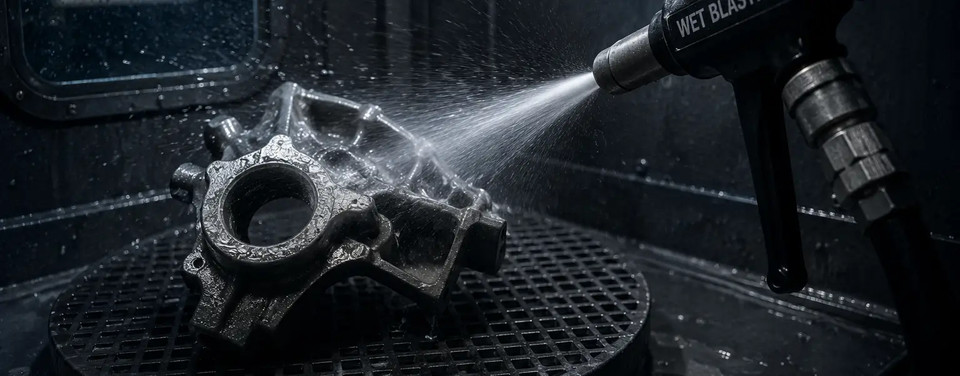
A conveyor wet blasting machine is an industrial surface treatment system that combines wet abrasive blasting with automatic workpiece transport. Instead of stopping the process for every fixture load, parts pass through a blasting chamber on a belt, roller, chain, hanging, or custom conveyor system. The blasting nozzles remain fixed or servo-controlled while the conveyor determines the part’s residence time inside the treatment zone.
Within the wet blasting process family, this machine type belongs to the inline or near-inline segment rather than the cabinet-style batch segment. The blasting medium is still a slurry of water and abrasive accelerated by compressed air, but the production logic changes significantly. The system is designed around flow, pacing, and line integration rather than isolated chamber cycles.
That distinction matters because many finishing problems are not caused by blasting energy alone. They are caused by variation in loading orientation, inconsistent dwell time, and operator-dependent handling. A conveyor wet blasting machine reduces those variables by presenting parts to the blasting zone in a more repeatable way, which is especially useful for repeat products, flat components, long stock, and takt-controlled manufacturing.
From a surface engineering perspective, the process combines the known benefits of wet blasting with a more automated transport method. Water suppresses dust, cushions impact compared with many dry systems, and can reduce the risk of abrasive impregnation on sensitive surfaces. The result is often a finer, more uniform finish with better control over matte appearance, burr removal intensity, oxide cleaning, or pretreatment consistency.
In industrial terms, the machine is best understood as a continuous-flow surface treatment platform. It can be built for single-lane, dual-lane, wide-part, rod-type, or overhead-transfer operation depending on the geometry and required output. Some systems are fully continuous, while others use indexed movement so that the part pauses briefly in one or more blasting stations.
The format is particularly relevant when batch chambers create a bottleneck. If the upstream and downstream processes already run in sequence, a cabinet-based workflow can add labor, queue time, and part-mix confusion. Conveyor-fed wet blasting addresses that by creating a more predictable material flow between machining, forging, additive manufacturing, coating pretreatment, cleaning, and inspection.
For buyers, the core selling points are not only productivity-related. A conveyor wet blasting machine also supports consistent part orientation, easier integration of standardized recipes, stable nozzle-to-part relationships, and a better foundation for traceable production control. Those characteristics are why conveyor systems are used not only for heavy industrial cleaning, but also for precision deburring and cosmetic surface conditioning.
How Does Conveyor Wet Blasting Machine Work
A conveyor wet blasting machine works by circulating slurry to blast nozzles, accelerating that slurry with compressed air, exposing moving workpieces to the blasting stream inside an enclosed chamber, and then recovering the used media-water mixture for recirculation and waste separation. The blasting principle is the same as in other wet blasting systems, but the timing and geometry are synchronized with conveyor transport.
Slurry Preparation and Wet Blasting Media Control
The first stage is slurry preparation. Water and abrasive are mixed in a tank or sump and kept in suspension by agitation or circulation so the particles remain evenly distributed. If the media settles excessively, the blast intensity can drift during operation, especially in longer production runs.
The slurry itself is a process variable, not just a consumable mixture. Media type, particle size distribution, concentration, contamination level, and breakdown rate all affect the final surface. In a conveyor wet blasting machine, those variables matter even more because the system is often expected to run continuously over extended periods rather than only for short batch cycles.
Compressed Air Acceleration and Nozzle Layout
The slurry is delivered to blast guns or manifolds, where compressed air accelerates the abrasive-water mixture toward the moving workpiece. Depending on the machine design, the nozzles may be arranged above, below, at the sides, or at multiple angles to cover edges, faces, slots, and formed surfaces. Wide parts may require overlapping spray patterns, while rods or profiles may need circumferential exposure.
Nozzle arrangement is tied directly to conveyor design. A flat belt is suitable for some parts but can shield the underside from treatment. Rollers, hanging fixtures, rotating supports, or pass-through orientation devices may be needed where multiple faces must be exposed. In other words, a conveyor wet blasting machine is never just a blasting cabinet with a motorized belt added; its transport system is part of the process architecture.
Conveyor Motion, Residence Time, and Surface Consistency
Once the part enters the chamber, the conveyor determines how long it remains in the blasting zone. In some systems the belt speed is constant. In others the line indexes part-to-part, or multiple zones operate with separate nozzle intensities. The finish is therefore a function of pressure, slurry condition, nozzle geometry, and conveyor speed together.
This is where conveyor speed control becomes crucial. If line speed drifts or workpieces tilt unpredictably, the surface result changes even when pressure remains stable. Production-grade systems therefore focus on repeatable part positioning, belt tracking, fixture orientation, and synchronization with the blast profile.
Closed-Loop Recovery, Sedimentation, and Mist Handling
After impact, the slurry drains back into the collection and recovery system. Reusable media and water are recirculated, while fines, broken abrasive, and removed contaminants are separated progressively through sedimentation, filtration, screening, or discharge systems. Effective closed-loop slurry recovery keeps the machine stable over long runs and reduces unnecessary consumable loss.
Water suppresses dry dust, but it does not eliminate the need for extraction. Wet blasting chambers still generate splash, mist, and suspended fine contamination that must be managed for visibility, cleanliness, and surrounding equipment protection. That is why industrial systems incorporate drainage design, enclosure sealing, and mist collection rather than relying on the water phase alone.
PID Pressure Control and Recipe Logic in Conveyor Wet Blasting
Because conveyor systems often run at production pace, process drift can affect a large number of parts before an operator notices a problem. PID pressure regulation helps maintain a more stable blasting condition across long shifts. Recipe logic can also store settings for line speed, nozzle grouping, pressure, slurry concentration targets, and dwell patterns for specific products.
Where geometry varies, servo-driven nozzle motion or X/Y/Z linkage may be introduced to maintain a more precise stand-off or sweep path. In simpler lines, the nozzles are fixed and process stability comes mainly from repeat part orientation and steady conveyor travel. In both cases, the principle is the same: keep the energy delivered to the surface inside a defined operating window.
In conveyor wet blasting, throughput only adds value when transport speed, slurry condition, and nozzle exposure stay synchronized.
| Process Parameter | Typical Conveyor Practice | Why It Matters |
|---|---|---|
| Working pressure | Typically controlled within an application-specific low-to-medium wet blasting range | Governs removal rate, finish quality, and substrate protection |
| Slurry concentration | Commonly maintained at a defined media-to-water ratio during running production | Affects cutting action, surface consistency, and media circulation stability |
| Abrasive particle size | Fine to medium particle ranges are typical depending on deburring, cleaning, or pretreatment goals | Changes texture, edge effect, and aggressiveness |
| Air flow demand | Sized to nozzle quantity, nozzle diameter, and conveyor duty cycle | Prevents pressure drop during continuous operation |
| Media consumption rate | Depends on contamination load, breakdown, carryout, and recovery efficiency | Influences operating cost and replenishment planning |
| Control system | PLC/HMI, recipe control, and often PID-regulated pressure in production-oriented systems | Supports repeatability, alarms, and line integration |
Conveyor Wet Blasting Machine vs Dry Blasting vs Other Methods
A conveyor wet blasting machine is best evaluated against other continuous or semi-continuous surface treatment methods, not only against batch cabinets. Buyers often compare it with conveyor dry blasting, shot peening lines, and vibratory finishing because each method can support production flow, yet each solves a different problem.
Dry blasting lines are commonly selected for aggressive cleaning or roughening when dust extraction infrastructure is already available and the substrate can tolerate a harder impact profile. Shot peening, as defined in broader shot peening process terminology, is typically chosen to introduce beneficial compressive stress rather than to deburr or pretreat for coating. Vibratory finishing excels at mass-finishing large volumes of smaller parts, but it is less selective and less suitable for long, flat, or orientation-sensitive components.
A conveyor wet blasting machine stands out when the line requires lower airborne dust, more controlled surface texture, and better compatibility with mixed materials or precision features. It is often particularly attractive for repeat metal parts, bar or rod stock, plate-shaped components, and pretreatment workflows guided by recognized surface cleanliness and preparation standards.
| Evaluation Dimension | Conveyor Wet Blasting | Dry Blasting | Shot Peening | Vibratory Finishing |
|---|---|---|---|---|
| Airborne dust generation | Low relative to dry blasting because water suppresses fines | High unless extraction is very strong | Moderate in enclosed cells | Low external dust, but wet compounds and media handling remain necessary |
| Surface finish character | Fine, uniform, and controllable in continuous flow | Often more aggressive and rougher by comparison | Surface texture is secondary to stress effect | Broad smoothing across exposed areas |
| Media embedding risk | Reduced on many soft or coated substrates | Higher on some sensitive materials | Depends on shot, hardness, and application objective | Not a blasting mechanism, so comparison is indirect |
| Best-fit production style | Continuous or indexed repeat production | Continuous cleaning and roughening | Dedicated fatigue-related processing | High-volume bulk finishing of smaller parts |
| Local feature control | Good with controlled orientation and nozzle layout | Good, but with greater dust burden | Moderate to high in dedicated peening systems | Lower selectivity on specific local features |
| Environmental profile | Cleaner chamber atmosphere, but slurry waste must be managed | More dust and dry waste handling | Dry enclosed process with media control needs | Requires management of compound, water, and media waste |
Key Specifications to Evaluate Before Buying
When specifying a conveyor wet blasting machine, the first question should be about the part path, not the blasting pressure. A system can have adequate blasting power and still fail in production if the conveyor cannot hold orientation, the line cannot match takt time, or the recovery circuit cannot keep the slurry stable through a full shift. Transport design and process design have to be evaluated together.
Conveyor Geometry and Part Presentation
The conveyor type should match the workpiece family. Belt conveyors are common for flat and plate-like parts, rollers can work well for bars or cylindrical stock, and custom fixtures may be necessary for delicate geometry. The buyer should verify how the chosen transport method exposes the workpiece surfaces to the nozzles and whether shielding or shadow zones will remain untreated.
Wide or long parts need special attention. If overlapping nozzle patterns are not balanced properly, the surface can show stripes or uneven texture across the width. That is why plate, rod, and profile applications often use application-specific machine layouts rather than a generic cabinet with a pass-through opening.
Pressure Control, Slurry Stability, and Nozzle Wear
Suppliers should explain not only the working pressure range, but how the system maintains it during long production runs. Nozzle wear, slurry contamination, and air supply fluctuation can all reduce consistency. Pressure stability is particularly important in inline finishing because many parts may pass through before variation becomes visually obvious.
Slurry stability matters just as much. The buyer should review agitation method, sediment management, replenishment logic, and how the machine prevents concentration drift. In a conveyor wet blasting machine, stable slurry behavior under continuous use is a stronger indicator of production readiness than peak pressure alone.
Throughput, Takt Matching, and Line Integration
Rated throughput numbers can be misleading if they exclude loading pitch, conveyor spacing, drying, and downstream handling. A more useful evaluation asks how many qualified parts the machine can deliver per hour at the required finish level. That includes belt speed, nozzle coverage, transfer spacing, and cleaning uniformity.
Integration points also matter. The buyer should review how the machine receives parts, how it discharges them, and whether inspection, rinsing, drying, or phosphating is required downstream. In some cases a combined line concept is more efficient than a stand-alone blasting tunnel.
Motion Accuracy, HMI, and Recipe Control
Not every conveyor wet blasting machine needs servo axes, but many benefit from programmable nozzle motion or zone selection. Where edges, recessed surfaces, or changing profiles matter, motion control can improve consistency beyond what fixed nozzles can provide. Systems with X/Y/Z linkage should be assessed at the actual blasting point, not only by nominal axis precision.
A capable HMI should store part recipes, speed settings, alarm history, maintenance prompts, and permission levels. For production plants running multiple shifts, recipe control helps preserve process repeatability while reducing reliance on operator memory. It also shortens changeover when the line alternates between validated part families.
Utilities, Mist Collection, and Maintenance Access
Utilities should be specified early. Conveyor wet blasting equipment typically requires stable compressed air, power, water management, drainage, and extraction. The equipment footprint must also include safe access for pump service, nozzle replacement, belt tracking, sludge removal, and chamber cleaning.
Maintenance accessibility is particularly important for continuous systems because downtime can halt the upstream or downstream line. Buyers should inspect access panels, sediment discharge points, and nozzle replacement procedures before finalizing the configuration. A machine that is difficult to maintain will rarely deliver stable long-run output.
A practical procurement checklist should therefore include:
- part size, weight, spacing, and orientation on the conveyor;
- required throughput in finished acceptable parts per hour;
- allowable surface finish band and removal-rate tolerance;
- conveyor type, belt material, roller arrangement, or hanging fixture logic;
- pressure regulation method and slurry concentration control;
- nozzle arrangement, overlap pattern, and wear-compensation approach;
- HMI recipe storage, alarm records, and permission hierarchy;
- extraction, drainage, and water-mist handling;
- safety interlocks, guarding, and maintenance access;
- downstream needs such as rinsing, drying, coating pretreatment, or inspection.
Applications Across Industries
Conveyor wet blasting machines are most valuable where the workpiece family is repeatable enough to justify guided transport, yet sensitive enough to benefit from wet abrasive control rather than aggressive dry cleaning. The process is common in metal finishing, forging support, bar and profile treatment, electronics housings, and selected tool and additive-manufacturing workflows.
In deburring environments, conveyor layouts can stabilize part presentation and improve takt consistency when compared with manual cabinets. For coating and conversion-coating lines, the process can also create a more uniform substrate entering paint, phosphating, or related pretreatment stages. Some factories use separate blasting and chemical stages, while others evaluate integrated concepts such as wet blasting phosphating equipment when process flow strongly favors combined pretreatment.
For geometry-specific production, the machine architecture often follows the part shape. Flat components may align with wet blasting for plate-shaped parts, while long cylindrical products can be closer to wet blasting for round rods. Where deburring is the main target, a conveyor layout may extend the same production logic discussed in burr removing of metal parts to a higher-throughput format.
| Application Type | Target Industry | Workpiece Example | Process Benefit |
|---|---|---|---|
| Edge honing | Cutting tool manufacturing | Repetitive tool blanks or fixtures carrying similar tools | More consistent exposure when part orientation can be standardized |
| Burr removal | Precision machining, stamping | Stamped brackets, housings, machined repeat parts | Stable deburring at line pace with lower operator dependence |
| Scale removal | Forging and steel processing | Steel bars, hot-worked parts, profile stock | Uniform oxide cleaning before downstream treatment |
| Pretreatment before coating | Automotive supply, fabricated hardware | Flat panels, brackets, formed metal parts | Cleaner, more even substrate before coating or chemical stages |
| AM post-processing | Additive manufacturing | Repetitive printed metal components | Improved consistency for surface cleanup across repeated builds |
| Light peening / conditioning | Mechanical components | Functional metal parts requiring controlled exposure | Repeatable surface conditioning in enclosed continuous flow |
| Glass frosting | Technical and decorative glass | Sheets, covers, display-related components | Uniform matte appearance with lower dry-dust burden |
| 3C device finishing | Electronics and consumer devices | Frames, covers, enclosures | Controlled cosmetic texture and smoother touch feel |
Equipment Selection Guide
A conveyor wet blasting machine should be chosen by matching transport logic to part geometry, finish sensitivity, and required output. Many projects go wrong because the buyer starts with chamber size or price level instead of part presentation. The right system is the one that keeps surfaces exposed consistently while fitting the plant’s actual takt and maintenance capability.
From R&D and Batch Validation to Conveyor Production
Some lines begin with application development in a non-inline format before shifting to conveyor production. A laboratory or sample-testing stage may still be necessary to define media grade, pressure window, and nozzle angle before the process is scaled. That is why certain projects start with a flexible validation platform and only later move into a dedicated pass-through design.
Standard production layouts can also coexist with conveyor systems. A plant may use a chamber machine for new-product introduction and a conveyor line for established high-volume parts. This staged approach is common when the process must be proven on variable parts before a transport-specific layout is frozen.
Matching Configuration to Shape, Speed, and Precision
Transport complexity rises with part complexity. Flat and rod-like parts are often the easiest to move consistently, while formed components may require nests, indexing, or programmable sweep paths. Production planners should therefore distinguish between general inline blasting and application-specific conveyor treatment.
The following matrix summarizes common configuration logic:
| Configuration / Model Tier | Target Production Scale | Workpiece Size Range | Precision Level | Recommended Applications |
|---|---|---|---|---|
| 1. Bench sample unit | Lab and feasibility testing | Very small parts | Moderate | Media selection and preliminary wet blasting trials |
| 2. Flexible R&D robotic cell | Development and sample validation | Small precision parts | High | Process development before inline scale-up |
| 3. Manual cabinet batch system | Small-lot production | Small to medium parts | Moderate | General cleaning, trial deburring, finish comparison |
| 4. Standard single-chamber production cabinet | Small to medium repetitive batches | Small to medium parts | High | Validated jobs not yet requiring pass-through flow |
| 5. Single-piece dedicated chamber | Repetitive discrete-part production | Medium parts | High | One-part orientation control per cycle |
| 6. Conveyor pass-through production system | Medium to high throughput | Flat, bar, or repeat-orientation parts | High | Deburring, scale removal, pretreatment, cosmetic finishing |
| 7. Geometry-specific conveyor system | Medium to high throughput | Plate, rod, profile, or custom parts | High to very high | Application-specific continuous wet blasting |
| 8. Double-chamber high-utilization system | Higher output where inline transport is not ideal | Small to medium repeat parts | High | Overlapped load/blast/unload with strong utilization |
Cost, Lead Time and ROI Considerations
The cost of a conveyor wet blasting machine is driven less by the blasting principle itself than by the transport and control architecture surrounding it. A simple pass-through belt design is one thing; a line with multiple blasting zones, precision part spacing, recipe-linked speed control, mist extraction, and downstream drying is another. Buyers should therefore treat “conveyor wet blasting machine” as a family of systems rather than a single price category.
The largest price driver is usually configuration complexity. Conveyor type, chamber width, nozzle count, enclosure design, and whether the line must process only top surfaces or multiple faces all affect the engineering scope. Custom fixtures, indexed motion, and special workpiece supports add cost because they are often application-specific rather than standard modules.
Automation level is the next major factor. Fixed-nozzle systems are generally simpler than servo-assisted nozzle arrays or integrated handling cells. However, if the product requires stable edge treatment, selective exposure, or tight cosmetic uniformity, extra automation may reduce long-run operating cost by cutting rework and inspection losses.
Slurry management and environmental control also matter. Continuous production typically demands more robust recovery, sedimentation, and waste-sand handling than a short-run cabinet. Mist extraction, belt washing, drainage design, and chamber cleaning access may not be the most visible line items, but they strongly influence uptime and maintenance labor.
Lead time should be viewed as illustrative, not absolute. Standardized production formats usually ship faster than custom conveyor systems matched to unusual geometry or complex plant layouts. Projects often take longer when they include sample validation, fixture development, multiple nozzle trials, or on-site coordination with upstream and downstream equipment.
ROI is usually calculated from a combination of throughput, labor reduction, quality consistency, and downstream process improvement. A conveyor wet blasting machine can reduce manual handling, stabilize exposure time, and support more predictable finishing than operator-dependent cabinet work. When it prevents coating defects, lowers scrap, or reduces secondary deburring labor, the payback logic becomes more compelling.
In some sectors, the return is tied to line balance rather than direct labor alone. If machining or forging output is waiting on a slower finishing stage, a conveyor system can remove a bottleneck and improve total equipment utilization. In others, the value comes from finishing repeatability: fewer visual rejects, more uniform pretreatment, and less process drift across shifts.
The most persuasive investment case usually appears where production has already outgrown batch handling, but a fully bespoke automated finishing line would be too rigid or too expensive. In that middle ground, a conveyor wet blasting machine offers controlled continuous flow without abandoning the surface-quality advantages of wet abrasive processing.
Why Choose DasiAuto?
Established in 2012, DasiAuto develops and manufactures wet blasting equipment for industrial surface treatment. The company brings together equipment engineering, abrasive media, and application development, as described in About DasiAuto.
Application testing and process development help evaluate abrasive media and treatment settings before the equipment configuration is defined. Equipment engineering can bring together the blasting system, fixtures, automation, and part handling around the application.
Suitability for a particular material, geometry, finish, or dimensional requirement needs to be established through representative sample testing. DasiAuto supports installation, operator training, and ongoing technical support through the production workflow.
FAQ
Is a Conveyor Wet Blasting Machine Better Than a Batch Cabinet for All Parts?
No. A conveyor wet blasting machine is usually better for repeat products, stable orientation, and medium-to-high throughput, but it is not automatically the best option for frequent part changeovers or highly mixed low-volume work. Batch chambers often remain more flexible for development, short runs, and irregular geometry.
Can Suppliers Run Sample Testing Before Finalizing a Conveyor Design?
Yes, and sample testing is especially important for conveyor projects because transport method affects the result as much as blasting pressure does. Trials help confirm nozzle arrangement, line speed, media grade, and whether the part needs a belt, roller, fixture, or indexed handling concept. Many buyers use this stage to verify whether a true inline layout is justified.
What Information Is Needed for an Accurate Quotation?
The supplier typically needs part drawings, material, dimensions, weight, target finish, required throughput, and photos of current defects or surface condition. It is also helpful to provide the intended upstream and downstream processes, because a conveyor wet blasting machine must fit the broader line logic. If the application is still uncertain, an engineer may need samples and takt targets before proposing the layout.
How Difficult Is Installation and Commissioning for a Conveyor Wet Blasting Machine?
Installation is usually more involved than for a stand-alone cabinet because the system must coordinate transport, utilities, drainage, extraction, and sometimes adjacent conveyors or drying stations. Commissioning should include blasting validation, speed setting, slurry conditioning, nozzle alignment, and operator training. The complexity increases when the machine is integrated into an existing production line instead of operating as an isolated cell.
What Consumables and Spare Parts Should Be Planned From the Start?
Typical planning includes blasting media, nozzles, hoses, seals, viewing protection items, and pump-related wear parts. Conveyor components such as belts, rollers, guide elements, or drive-related consumables may also be relevant depending on the transport design. A well-prepared spare-parts plan helps keep the line stable during long continuous runs.
How Should After-Sales Support and Warranty Be Evaluated?
Warranty matters, but in conveyor applications the more important issue is how quickly the supplier can support process recovery if output quality drifts. Buyers should review spare-parts availability, technical response time, training support, abrasive resupply, and whether post-installation parameter optimization is available. For a conveyor wet blasting machine, dependable support is closely tied to long-term production stability rather than repair coverage alone.