

Edge honing deliberately changes a cutting edge to an agreed profile. Wet blasting uses abrasive suspended in water and directed with compressed air to carry out that preparation. The objective is a defined transition at the edge, with the surrounding tool features kept within their requirements.
Edge rounding and the treatment of varied insert geometries are central to this application. The aim is to address edge chipping and wear through a suitable edge condition. Start by defining what a particular cutting task needs and how the finished edge will be verified.
The Edge Requirement
Specify the Edge You Need
Start with the tool drawing and its intended cutting operation. “Honed” alone does not describe the target well enough for equipment selection or finished-tool acceptance.
- Edge Profile: Define the required radius or other specified edge form, including any permitted asymmetry.
- Treatment Locations: Mark which cutting edges, corners and adjacent surfaces belong in the process.
- Incoming Condition: Provide the tool material, grinding condition and any existing edge defects.
- Acceptance Method: Agree where the edge will be measured and how variation will be assessed.
For a drawing that uses K-value or another edge-profile convention, include its definition and the measurement method. The same label should mean the same thing to the tool designer, equipment supplier and inspector.
The Edge in View
Before-and-After Edge Examples
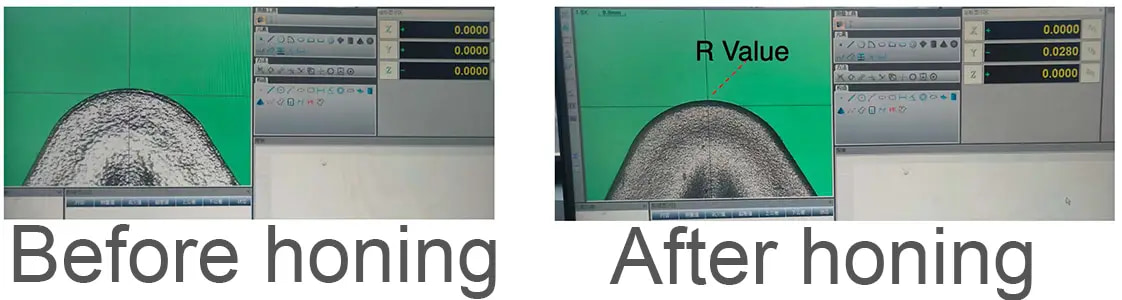
The before-and-after views show different edge outlines and illustrate the transition sought through honing. Treat these as qualitative examples; set acceptance using the specified edge profile and measurements on the actual tool.
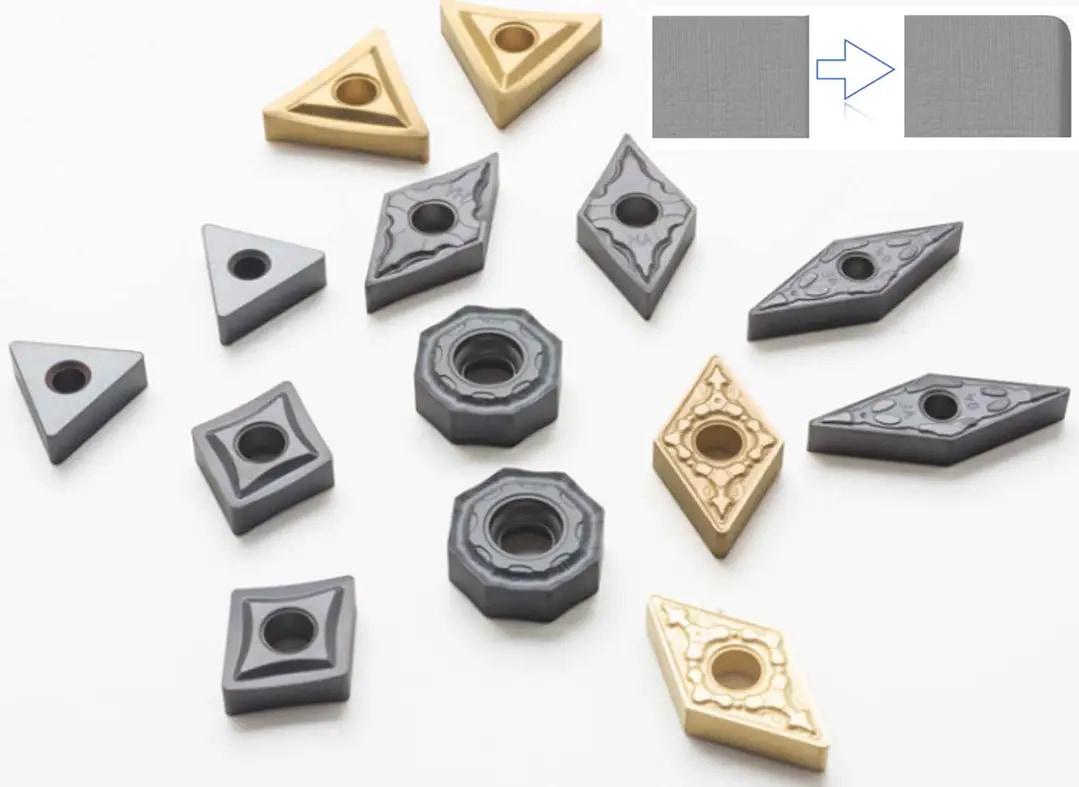
The insert illustration shows several outlines and an inset edge detail. Use the different geometries to discuss treatment locations, corner exposure and how each tool will be presented to the abrasive stream.
Process Control
Match Abrasive Exposure to Tool Geometry
Discuss abrasive selection, pressure, nozzle position and treatment time together with the target edge. The process needs to account for the edges that face the nozzle and those presented at a different angle as the part moves.
For each tool family, review corner exposure, edge accessibility and the way the part is held. Ask how orientation and treatment sequence will be repeated when parts or fixtures change. Include the full cutting-edge path in the review, particularly where its direction changes around a corner.
Agree the allowed change to adjacent faces and any features that require protection. Cleaning and drying should also be included in the proposed route so that edge inspection evaluates the finished tool condition.
Equipment Selection
Compare Published Equipment Approaches
DasiAuto lists insert honing in the published application parameters for DC-40 Double Chamber Equipment and SC-40 Single Chamber Equipment. These provide starting points for discussing tray-based insert treatment.
The SP1580 Single Piece Equipment page describes individual insert treatment, an adjustable nozzle angle and controllable part rotation. Review that approach when individual presentation and edge-profile control are central to the requirement.
Choose between handling approaches using the actual insert geometry, part mix and required production quantity. Agree the final configuration, acceptance limits and output for the proposed parts. The wet blasting equipment overview brings the published handling approaches together for comparison.
Evaluate the Result
Evaluate Geometry and Cutting Performance Separately
First establish whether treated samples meet the specified edge profile and surrounding surface requirements. Check the agreed locations on representative tools, including corners and other areas where treatment may differ.
Then evaluate cutting performance under the intended use conditions if wear or tool life is part of the objective. Use representative tools and agreed cutting conditions, keeping this performance assessment separate from acceptance of the edge geometry.
Where honing is followed by coating, also confirm the required cleanliness and substrate condition with the coating route. Cutting Tool Coating Preparation addresses that related surface-preparation objective.
Your Application Brief
What to Provide for an Application Review
Provide the tool drawing, material, edge-profile definition and representative untreated tools. Include existing measurements, the required inspection locations and any accepted reference samples.
Add the intended cutting operation, coating sequence where applicable, permitted changes to adjacent surfaces, part mix and production quantities. This information connects the edge requirement to a practical handling method and a clear finished-tool acceptance plan.